
AI model orchestration is the control plane that coordinates models, agents, pipelines, and applications so they behave as one governed system rather than a pile of scripts. If your organisation runs more than one model or agent that must hand off work, share context, or answer to a compliance team, you need it.
Orchestration coordinates a wider set of moving parts than most teams expect at first:
- Large language models and traditional ML endpoints
- Autonomous or semi-autonomous agents
- Vector stores and retrieval pipelines
- Tool calls and external API invocations
- Multi-step workflows with conditional branching
The industry-standard framing, as IBM describes it, treats orchestration as middleware infrastructure that governs models, agents, data pipelines and business applications together, rather than leaving each to run in isolation. Rule of thumb: once two or more models or agents must coordinate under a shared policy, budget, or audit requirement, ad hoc scripting stops scaling. Agentria applies this exact logic inside online casino support, routing player messages across multiple AI providers from its own admin console, logging every pipeline run for audit, and routing anything the quality agent doesn’t approve to a human reviewer before it reaches a player.
Key Takeaways
Effective AI model orchestration requires deterministic replay, runtime policy enforcement, and human-in-the-loop checkpoints working together, not any single capability alone.
| Point | Details |
|---|---|
| Orchestration is a control plane | It coordinates models, agents, pipelines and tools under shared governance, not just task execution. |
| Replay enables safe testing | Deterministic replay lets teams regression-test prompt and model changes against recorded state. |
| Governance must enforce, not just detect | Runtime policy enforcement blocks non-compliant outputs before they ship, unlike detection-only logging. |
| Avoid lock-in with portability | Open metadata formats and multi-cloud support prevent costly migration later. |
| Agentria applies these patterns live | Multi-provider routing, configurable human review and full audit trails support regulated casino player support. |
Table of Contents
- How does AI model orchestration actually work?
- What components make up an orchestration layer?
- Orchestration vs. agents, MLOps, and API gateways: what owns what?
- What business problems does orchestration actually solve?
- How do you evaluate an orchestration platform without locking yourself in?
- How do you roll out orchestration from prototype to production?
- How does Agentria orchestrate AI for regulated player support?
- What are the security and privacy implications of AI orchestration?
- How do you monitor orchestrated systems beyond basic observability?
- How should orchestration handle model versioning and rollbacks?
- What orchestration frameworks and tools exist today?
- What actually matters most in AI model orchestration?
- Get orchestration built for regulated player support, not generic workflows
- Sources
How does AI model orchestration actually work?
Underneath the term “orchestration” sits a fairly concrete execution model, and it’s worth understanding the mechanics before you evaluate any platform.
Most orchestration engines run on directed acyclic graphs (DAGs) or event-driven triggers. A DAG defines fixed steps and their order: retrieve, generate, validate, respond. Event-driven triggers instead react to something happening, a new support ticket, a fraud flag, a webhook, and kick off the appropriate workflow on demand. Increasingly, agentic systems use a third pattern: the plan-act-validate loop, where an agent proposes a plan, executes a step, checks the result against expectations, and either continues or replans. This loop is what lets an agent recover from a failed API call without a human rewriting the workflow.
State and memory management sits underneath all three patterns. An orchestration layer needs to track what has already happened in a session (short-term memory), what a user or account has done historically (long-term memory), and what intermediate outputs earlier steps produced. Without this, a multi-turn agent forgets its own decisions between steps, and debugging becomes guesswork. Reproducibility depends on capturing this state consistently, because two runs with slightly different context will produce different outputs even from an identical prompt.
Retrieval-augmented generation (RAG), tool calls, and function-calling are the three runtime patterns doing most of the work inside modern orchestration. Dataiku’s architecture breakdown describes an orchestration layer as one that sequences retrieval, ranking, context assembly, generation and output validation as a single coordinated cycle rather than four disconnected steps. Tool calls extend this further, letting a model invoke a calculator, a database query, or an internal API mid-conversation, with the orchestration layer managing the round trip.
- A trigger fires (user message, scheduled job, or webhook).
- The orchestrator selects the workflow and loads relevant state.
- Retrieval and tool calls populate context for the model.
- The model generates a response, which passes through validation.
- The execution, inputs, and outputs are logged for replay.
That last step matters more than it looks. ZenML’s approach to unified execution treats pipelines and agent runs as governed by the same metadata store, so every run can be replayed deterministically against recorded state. That’s what makes regression testing possible: you can test a new prompt or model version against yesterday’s real traffic without exposing live players to an untested change.
Pro Tip: Before optimising for speed, instrument replay first. Teams that skip deterministic logging in the prototype phase almost always end up bolting it on later, at far higher cost, once an auditor or a regression bug forces the issue.
What components make up an orchestration layer?
Ask any architecture team to spec an orchestration platform and five categories of component always come up, whether the vendor calls them by these names or not.
Integration hooks connect the orchestrator to everything it needs to reach: model providers (OpenAI, Anthropic, open-weight endpoints), vector databases, internal REST or gRPC APIs, and legacy systems of record. This is the surface area that determines whether you can add a new model provider in an afternoon or a quarter.
Scheduler and routing logic decides how work actually executes. This covers parallelism (running independent steps concurrently), retries with backoff when a provider times out, hard timeouts to prevent a stuck call from blocking a workflow, and fallback routing to a secondary model when a primary one is degraded or too expensive for the task at hand.
Artifact versioning and model registry functions give you lineage: which model version, which prompt template, which retrieved documents produced a given output. ZenML’s MLOps layer records executions and versions artifacts specifically so teams can trace any output back to its exact inputs, which is the backbone of both regression testing and compliance reporting.
Observability in this context goes beyond generic uptime monitoring. You need latency per step, error rates by provider, token usage and cost per request, and some measure of output quality, whether that’s a validation pass rate or a sampled human review score.
Governance primitives close the loop:
- Runtime policy enforcement that blocks non-compliant outputs before they ship, not just flags them afterwards
- Role-based access control over who can modify workflows or approve overrides
- Immutable audit logs covering every decision and escalation
- Human-in-the-loop checkpoints at defined risk thresholds
Dataiku’s research is blunt about the failure mode here: governance that only detects problems after the fact isn’t governance, it’s a postmortem. Enforcement has to happen at runtime, before an output reaches a customer or a regulator’s audit file.
Orchestration vs. agents, MLOps, and API gateways: what owns what?
Confusion between these four layers is probably the single biggest source of duplicated tooling in enterprise AI teams, so it’s worth drawing the boundaries plainly.
An agent is a loop: it plans, acts, and evaluates its own results, usually to accomplish one task or a narrow class of tasks. Orchestration is the layer above that decides when an agent runs, what context it receives, and when control passes back to a human or another system. IBM frames orchestration as exactly this: the control plane that governs when agents run and when they hand off to human review, not the agent’s own reasoning loop.
MLOps owns the model’s lifecycle: training, validation, versioning, and deployment of a single model or a small family of related models. Orchestration picks up where MLOps stops, coordinating multiple deployed models, agents, and pipelines into a single workflow that spans providers and systems.
An API gateway manages traffic, authentication, and rate limiting for API calls generally. It has no concept of workflow state, retries tied to business logic, or multi-step sequencing, which is precisely the gap orchestration fills.
| Layer | Owns | Doesn’t own |
|---|---|---|
| Agent | Task-level plan-act-evaluate loop | Cross-system coordination, governance |
| MLOps | Model training, versioning, deployment | Multi-model workflow logic |
| API gateway | Traffic, auth, rate limiting | Workflow state, business retries |
| Orchestration | Workflow sequencing, state, governance across all of the above | Model training itself |
The organisational fallout of blurring these lines is predictable: ML engineers end up owning workflow logic they didn’t design for, platform teams build brittle custom glue-code to connect systems that were never meant to talk directly, and testing paths fragment across teams. Dataiku’s research on this failure mode calls it the glue-code trap specifically because it’s rarely a deliberate architectural choice. It’s what happens when nobody owns the coordination layer, so everybody improvises one.
What business problems does orchestration actually solve?
The technical capability only matters if it moves a number a decision-maker cares about, so it’s worth being specific about where orchestration earns its keep.
Customer service triage and escalation is the clearest example. A single incoming message gets classified, routed to the right specialist model or knowledge base, and escalated to a human when sentiment or risk crosses a threshold, all without a human touching the triage step itself.

RAG knowledge workflows let support and research teams query internal documentation or policy databases through retrieval pipelines that stay current without manual reindexing.
Fraud detection chains run multiple models in sequence, a fast screening model followed by a slower, more expensive verification model only for flagged cases, which keeps compute cost proportional to actual risk.
Supply chain optimisation coordinates forecasting models, inventory systems, and supplier APIs into a single decision pipeline rather than separate dashboards that humans reconcile manually.
The measurable benefits tend to cluster around four things:
- Faster resolution times, because triage and routing happen in seconds rather than a queue
- More consistent outputs, since the same policy and validation logic applies to every run
- Better compliance posture, backed by replayable execution logs that satisfy audit requirements
- Lower cost per resolution, achieved by routing simple queries to cheaper models and reserving expensive ones for genuinely hard cases
The metrics worth tracking in production are task completion quality (did the workflow actually resolve the request), cost per resolution, drift alerts on model output distributions, and end-to-end latency. Teams that only watch uptime miss the slow, gradual quality decay that model drift causes long before anything actually breaks.
How do you evaluate an orchestration platform without locking yourself in?
Vendor lock-in is the quiet cost that shows up eighteen months after a platform decision, not during the proof of concept. Four criteria separate portable choices from expensive ones.
- Portability first. Favour platforms that use open metadata formats and support multi-cloud or hybrid deployment. A platform-agnostic approach is what stops a provider price increase or an outage from becoming an existential problem for your workflows.
- Replay and lineage aren’t optional extras. If a platform can’t replay a past execution deterministically against recorded state, you can’t regression-test prompt or model changes safely, and you can’t produce a clean audit trail when a regulator asks how a specific decision was made.
- Governance has to be enforced at runtime, not just logged. Ask vendors directly whether policy violations are blocked before execution or merely flagged in a dashboard afterwards. The difference is the entire point of governance.
- Understand the real cost model. Orchestration overhead includes compute for the orchestration layer itself, not just the models it calls. Autoscaling and cost controls (routing to cheaper models by default, capping retries) need to be built in from day one, not retrofitted once a bill arrives.
- Check the integration surface. How easily can you add a new model provider, a new tool call, or a new internal API? Durable runtimes like Flyte are built specifically for infra-aware recovery and dynamic branching in agent-native workflows, which matters if your workflows need to adapt mid-execution rather than fail and restart from scratch.
Pro Tip: Run a lock-in stress test before signing anything: ask the vendor to export your workflow definitions, state, and audit logs in an open format, then check whether a competitor’s platform could actually ingest them. If the answer is no, you’ve found your real switching cost.
How do you roll out orchestration from prototype to production?
Moving from a working demo to a governed production system is where most orchestration projects either earn their budget or quietly stall. Five steps, in order, keep the rollout disciplined.
- Define a bounded workflow with measurable success criteria. Pick one workflow, ideally something with a clear pass/fail outcome like ticket resolution or fraud flag accuracy, rather than trying to orchestrate everything at once.
- Record every run and enable deterministic replay from day one. This is the single hardest thing to retrofit later, and the unified execution model ZenML uses exists precisely so pipelines and agent runs can be replayed for regression testing before anything ships.
- Set policy gates and human-in-the-loop thresholds explicitly. Decide in advance which outputs need human sign-off, based on risk category or confidence score, rather than discovering the gap after an incident.
- Build observability and cost controls before wide rollout, not after. Latency, error rate, token spend and output quality dashboards need to exist before you scale traffic, not once volume has already made problems expensive to unwind.
- Plan prompt and model versioning with a rollback path. Every prompt template and model version should be tagged, so if a new model degrades output quality, you can revert to the last known-good configuration in minutes, not days.
Pro Tip: Treat your first production workflow as a template, not a one-off. Teams that document the pattern (trigger, state schema, validation rules, rollback path) from workflow one save weeks when scaling to workflow ten.
How does Agentria orchestrate AI for regulated player support?
Online casino support sits under some of the tightest regulatory scrutiny in consumer tech, which makes it a genuinely demanding proving ground for orchestration patterns. Agentria was built around three proof points that map directly onto the components covered above.
- Multi-provider integration: player messages route across several AI providers rather than depending on a single model, reducing exposure to any one provider’s outage or quality dip.
- Human-in-the-loop review: staff review can gate every AI-generated reply before it reaches a player, which is the human-in-the-loop checkpoint discussed earlier applied at its strictest setting.
- Compliance-ready audit trail: every decision, from initial triage to final human approval, is logged, giving operators a complete record for regulators without manual reconstruction.
The workflow itself follows a triage-specialist-review pattern: an incoming message (email, live chat, SMS, or Telegram) gets classified for intent and sentiment, handed to the pipeline agents configured for that brand and to the operator persona best suited to the player’s language and thread history, VIP escalation applied where relevant, and and the drafted response either released automatically once the quality agent approves it, or held for a human reviewer when the brand requires approval. It’s the same triage-and-escalation pattern described in the enterprise use cases above, adapted to the specific compliance demands of regulated gambling.
The operational payoff mirrors what the benefits section predicted in the abstract: faster response times because triage and drafting happen automatically, stronger auditability because every step is logged for compliance review, and clearer operational analytics because the same platform captures resolution times and sentiment trends in one dashboard.
| Point | Details |
|---|---|
| Multi-provider routing | Reduces single-provider dependency and outage risk across channels. |
| Human review gate | Drafts wait for staff sign off, or auto send when the pipeline scores them high confidence — auto resolve is the per-brand switch. |
| Full audit trail | Every triage and escalation decision is logged for regulatory review. |
What are the security and privacy implications of AI orchestration?
Orchestration widens your attack surface by design, because it connects models, tool calls, and data stores that used to sit in isolation. Every integration hook is a potential entry point, and every tool call an agent can invoke is a capability an attacker could try to hijack through prompt injection.
Data privacy adds a second layer of risk. When a workflow pulls player or customer records into a prompt for a vector database query, that data now flows through a model provider’s infrastructure, however briefly. In regulated industries, this makes data residency and provider-level data handling agreements non-negotiable checks before a workflow goes live, not afterthoughts.
Role-based access control needs to apply not just to who can view outputs, but to who can modify workflow logic, adjust policy thresholds, or approve overrides. A support agent shouldn’t be able to loosen a compliance gate without a separate approval step. Runtime policy enforcement, blocking a non-compliant output before it ships rather than flagging it afterwards, does double duty here: it’s both a governance control and a security boundary against a compromised or manipulated model output reaching a customer.
Encryption in transit and at rest for logged executions matters more than it sounds, because replay logs and audit trails, by their nature, contain the same sensitive context the original workflow processed. An audit trail that satisfies a regulator but leaks player data through weak access controls has simply moved the compliance risk rather than solving it.
How do you monitor orchestrated systems beyond basic observability?
Standard observability, latency, error rates, uptime, tells you a system is running. It doesn’t tell you whether it’s still doing its job well, which is a different and often quieter failure mode.
Alerting needs to catch three categories that dashboards alone tend to miss. Quality decay: a model can stay online and fast while its output quality slowly drifts, particularly after a provider pushes an unannounced model update. Sampled human review scores, tracked over time and alerted on when they dip below a threshold, catch this before customer complaints do.
Cost anomalies: a workflow that starts routing more traffic to an expensive model, whether from a routing bug or genuine demand shift, needs an alert tied to spend velocity, not just a monthly bill review.
Escalation pattern shifts: a sudden spike in human-in-the-loop escalations often signals either a genuine change in incoming request types or a model degrading in confidence. Either way, it’s worth an alert rather than a quarterly report.
The practical approach is layered alerting: hard thresholds for obvious failures (timeouts, error spikes), statistical alerts for gradual drift (rolling averages on quality scores), and pattern alerts for anomalies in escalation or cost trends. Teams that rely solely on uptime dashboards typically discover quality problems only once a customer or a regulator flags them, which is the most expensive way to find out.
How should orchestration handle model versioning and rollbacks?
Every model, prompt template, and workflow configuration in an orchestrated system needs a version identifier, tracked with the same discipline software teams apply to code releases. Without this, “which model produced this output” becomes a forensic exercise instead of a lookup.
Artifact versioning and a proper model registry, the same components covered earlier in the orchestration layer’s architecture, are what make rollback possible in practice. When a new model version or prompt update degrades output quality, the fix should be a configuration change back to the last known-good version, not an emergency deployment.
Rollback paths work best when they’re tested before they’re needed. That means periodically simulating a rollback in a staging environment, confirming state and memory schemas remain compatible across versions, and checking that a rollback doesn’t silently break a downstream workflow that assumed the newer version’s output format. A/B testing new model versions against a small percentage of traffic, with automatic rollback triggers tied to quality or error thresholds, catches most regressions before they reach full production volume.
The deterministic replay capability discussed earlier does double duty here. If you can replay a past execution against a proposed new model version, you can validate the rollback decision itself, confirming the older version genuinely performed better on the same inputs, rather than relying on gut feeling about which version was “better.”
What orchestration frameworks and tools exist today?
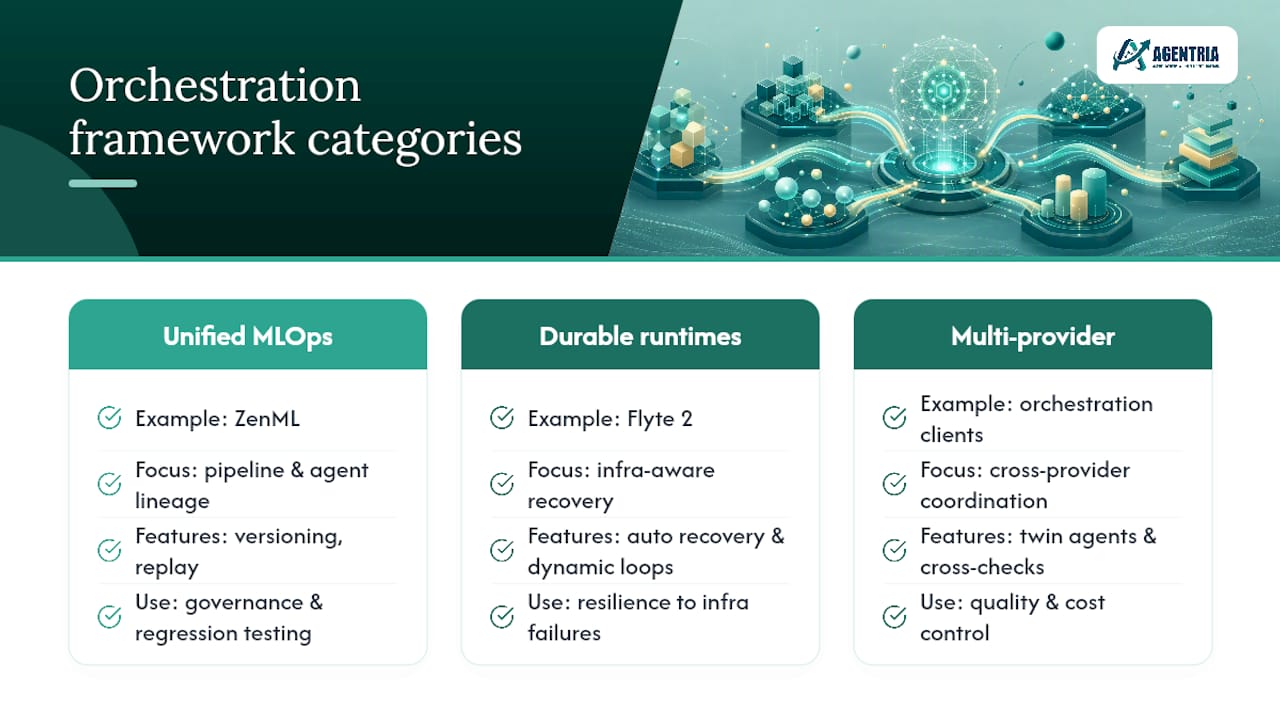
The market splits roughly into three categories, and knowing which one you’re evaluating avoids a lot of mismatched expectations.
Unified MLOps and AI orchestration layers treat pipelines and agent workflows as governed by the same metadata store. ZenML is a clear example here, offering artifact versioning, execution recording, and deterministic replay across both traditional ML pipelines and newer agentic flows, which is precisely the lineage and regression-testing capability compliance-heavy teams need.
Durable, agent-native runtimes focus on infra-aware recovery and dynamic workflow branching. Flyte 2 is built around this exact use case, advertising automatic recovery from infrastructure failures like out-of-memory errors and node interruptions, alongside dynamic looping for agents that need to adapt their own execution path mid-run.
Multi-provider orchestration clients sit closer to the application layer, coordinating calls across multiple model providers within a single request or workflow. Techniques like cross-pollination, running twin agents on different providers and comparing their outputs, improve output reliability by catching hallucinations that a single-model approach would miss entirely.
None of these categories fully replaces the others. A mature enterprise stack often combines a lineage-focused layer for governance and testing with a durable runtime for resilience, plus multi-provider routing at the application layer for quality and cost control. Evaluating a single tool against all three categories’ criteria is usually the fastest way to pick the wrong one.
What actually matters most in AI model orchestration?
The judgement this article’s research supports is unambiguous: orchestration without enforceable governance is not orchestration, it’s just faster automation with worse accountability. Coordinating models and agents is the easy half of the problem. Making every decision replayable, auditable, and reversible is the half that actually protects a business.
Where conventional advice falls short is in treating orchestration as a purely technical integration problem, wiring up model calls and calling it done. That framing ignores the organisational reality: once an orchestrated workflow touches customer data or regulated decisions, the governance layer stops being optional infrastructure and becomes the thing that determines whether the system survives an audit.
Prioritise replay and lineage before you prioritise speed or scale. A workflow you can’t replay deterministically is a workflow you can’t safely improve, because you have no reliable way to prove a change made things better rather than just different. Get that foundation right first, and the scaling problems, cost routing, provider redundancy, latency, become far easier to solve on top of it.
— AGENTRIA
Get orchestration built for regulated player support, not generic workflows
Agentria isn’t a general-purpose orchestration framework you assemble yourself, it’s the specific application of these patterns to online casino and iGaming support, already built with the governance layer regulators expect. Where a generic orchestration platform leaves you to design your own audit trail, policy gates, and human review checkpoints from scratch, Agentria ships with those already wired into the workflow: multi-provider routing across channels, a review gate you set per brand, and a complete audit trail for every decision.
That matters most for operators who need to prove compliance on demand, not reconstruct it after the fact. If you’re running player support across email, live chat, SMS, or Telegram and need the routing, escalation, and review logic already covered in this article without building it in-house, explore Agentria’s platform or book a demo to see the orchestration and audit trail in action on your own support volume.
Sources
- What is AI Orchestration? | IBM
- ZenML — The unified layer for ML and AI
- What is an AI orchestration layer? Architecture, benefits, and enterprise use cases
- Flyte — Durable AI runtime
Recommended
See AGENTRIA on your support workflow
Book a walkthrough tailored to your brands, channels, and compliance requirements.