
If speed and scale matter most, a chatbot wins. If the conversation is emotionally loaded, high-value, or genuinely complicated, a human on live chat wins. For most operations handling any real volume, the right answer is neither one alone. It’s a hybrid, where a chatbot handles the first response and clears the easy stuff, then hands off to a live agent with full context when things get hard.
The evidence backs this up. Chatbots respond in seconds and never sleep, but live chat still closes more complex or high-stakes conversations because a person can read tone and adapt on the fly. Hybrid setups that combine both typically post higher resolution rates and better CSAT than either channel running solo.
Here’s what the rest of this article covers, and the one thing to do next:
- Clear definitions so “chatbot,” “live chat,” and “AI agent” stop getting used interchangeably
- A head-to-head comparison across cost, speed, and complexity
- A decision checklist you can apply this week
- Handoff rules that actually prevent the most common hybrid failures
Key Takeaways
The strongest support strategy isn’t chatbot or live chat. It’s a hybrid model with tight handoff rules, measured against deflection, resolution, and CSAT weekly.
| Point | Details |
|---|---|
| Match the channel to the task | Chatbots handle repetitive, high-volume questions; live chat handles complexity, emotion, and high-value accounts. |
| Hybrid beats either alone | Combined AI-first, human-handoff models post higher resolution and CSAT than single-mode deployments. |
| Handoffs need structure | Pass full transcripts, a summary of the issue, and estimated wait time every time a bot escalates. |
| Watch repeat-contact rate | Rising repeat contacts signal knowledge-base gaps faster than CSAT does. |
| Disclosure isn’t optional | Customers must know when they’re talking to a bot and always have a path to a human. |
| Agentria fits regulated volume | Agentria pairs AI response speed with human review and audit trails built for compliance-heavy operators like iGaming. |
Table of Contents
- Chatbot vs Live Chat: What’s the Real Difference?
- How Do Chatbots and Live Chat Compare Head to Head?
- Pros and Cons of Chatbots and Live Chat for Business
- Which Should You Choose: Chatbot, Live Chat, or Hybrid?
- How Do You Build a Hybrid Handoff That Actually Works?
- What KPIs and Infrastructure Does a Rollout Actually Need?
- How AGENTRIA Handles the Chatbot vs. Live Chat Trade-Off
- What the Data Actually Tells Decision-Makers to Do
- Get Started With Hybrid Player Support Built for Regulated Markets
- Frequently Asked Questions
- Sources
Chatbot vs Live Chat: What’s the Real Difference?
Live chat (sometimes called webchat) is a real-time text conversation with a human support agent. UK government guidance defines it plainly: webchat means talking to a human advisor, full stop. If a bot is involved, it has to be clearly labeled as one.
A rule-based chatbot follows scripted decision trees. Type “refund,” get a refund flow. It’s fast and predictable but breaks the moment a question falls outside its script.
An AI chatbot uses natural language processing to understand intent and generate responses from a knowledge base, rather than following a fixed script. It handles more variation but still just answers questions.
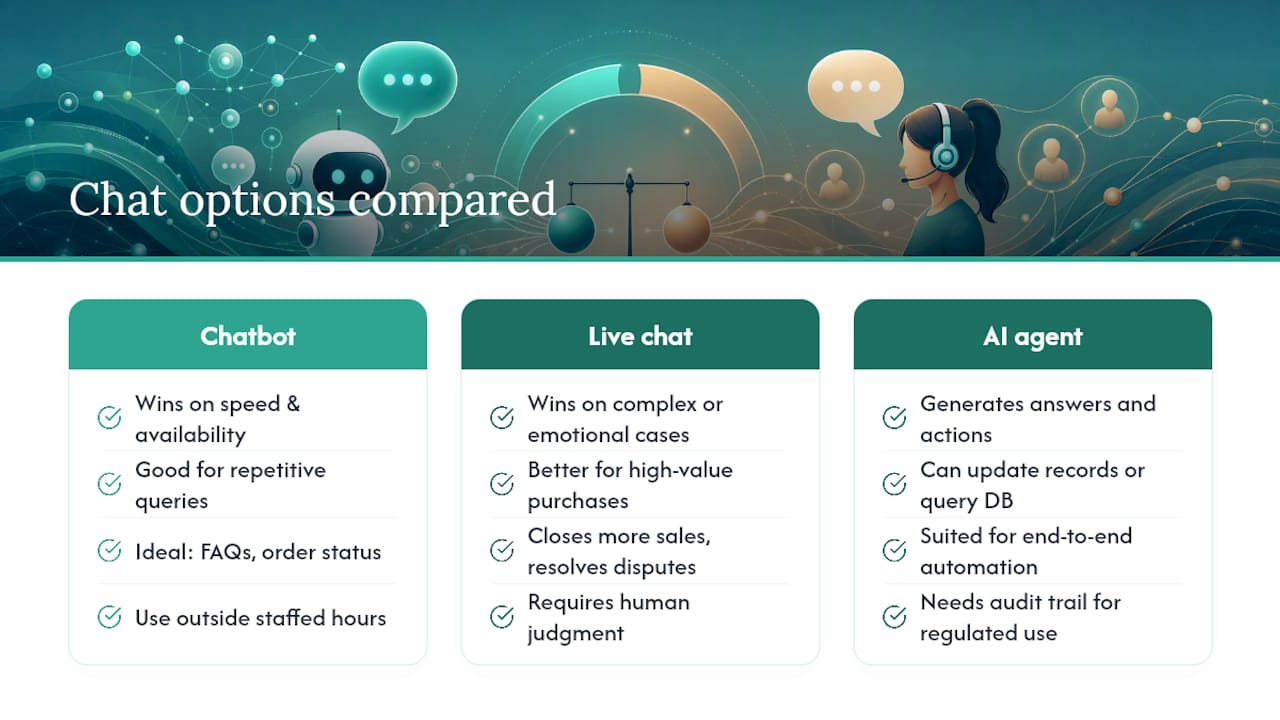
An AI agent goes further. It can take action, like querying a database, updating a record, or triggering a workflow, not just reply with text. Salesforce’s framing draws this line clearly: chatbots talk, agents do.
Quick summary of strengths and limits:
- Live chat: strong on empathy and judgment; limited by staffing costs and hours
- Rule-based chatbot: cheap and predictable; brittle outside its scripted paths
- AI chatbot: flexible and fast; needs a maintained knowledge base to stay accurate
- AI agent: can resolve issues end-to-end; requires deeper integration and more oversight
The distinction matters beyond semantics. In regulated industries like gambling or finance, mislabeling a bot as a human, or letting an agent take unsupervised action on an account, creates real compliance exposure.
How Do Chatbots and Live Chat Compare Head to Head?
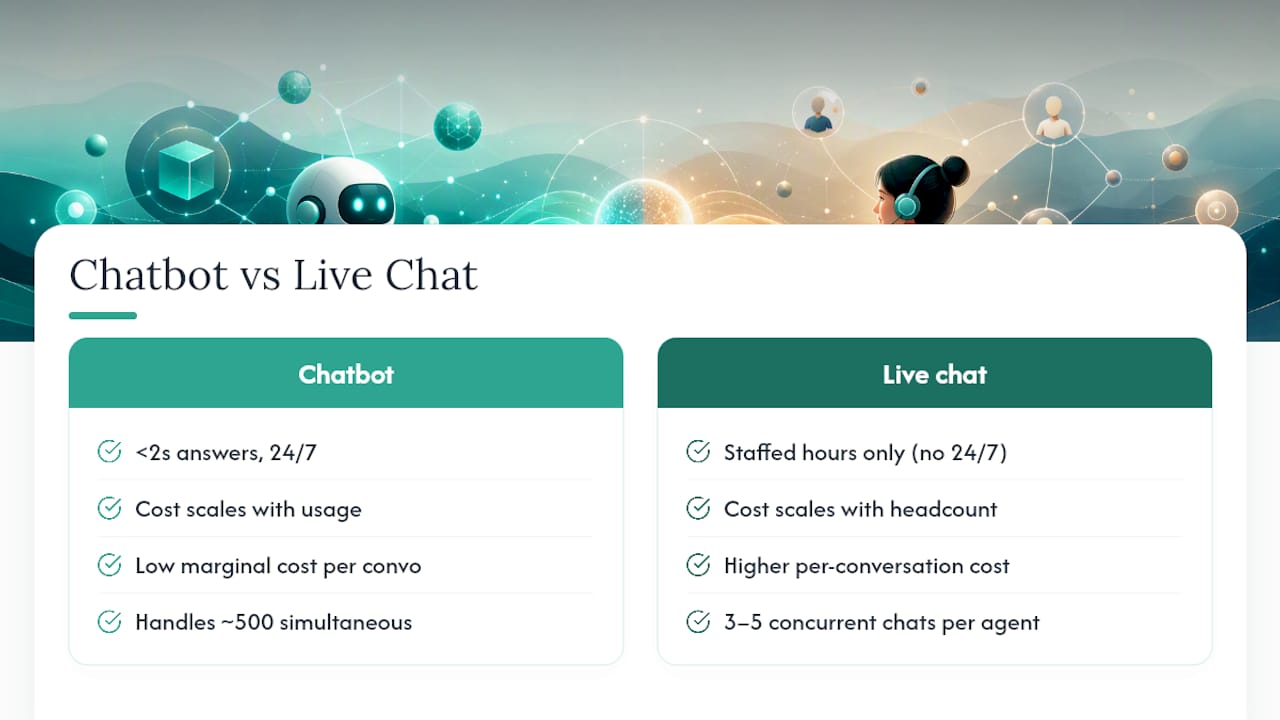
Response time and availability. A well-built chatbot answers in under two seconds and runs 24/7, which matters enormously if your traffic skews toward evenings or weekends. Live chat is bound by staffing. Even with a global team, most operators can’t justify round-the-clock human coverage for every channel.
Cost and scaling. Live chat costs scale with headcount. Every agent added means recruiting, training, and scheduling. Chatbot cost scales with usage, but the marginal cost per additional conversation is far lower than adding another agent. That’s why IBM’s analysis treats chatbots primarily as a workload-reduction tool for high-volume, repetitive requests, not a full agent replacement.
Complexity and resolution. This is where live chat still wins outright. A frustrated VIP player disputing a withdrawal, or a customer with an account issue tangled across three systems, needs judgment a script doesn’t have. Push that kind of ticket through a bot and you get a dead end, plus a worse experience than if you’d never automated it.
Scalability. A chatbot can run 500 simultaneous conversations without breaking a sweat. Live chat agents typically handle three to five concurrent chats before quality drops.
The numbers that matter: hybrid deployments (AI handles first contact, humans take the handoff) consistently produce higher combined resolution and satisfaction scores than pure chatbot or pure live chat setups, according to LoopReply’s 2026 analysis.
CSAT and revenue impact. Fast first response boosts satisfaction almost regardless of channel. But for high-value interactions, the presence of a human closes more sales and resolves more disputes. That’s the trade-off in one sentence: chatbots protect your response-time metrics, live chat protects your revenue-per-conversation on the conversations that matter most.
Pros and Cons of Chatbots and Live Chat for Business
Chatbot advantages:
- Instant response around the clock, including holidays and 3 a.m. traffic spikes
- Low marginal cost per conversation once the knowledge base is built
- Captures leads and answers FAQs outside business hours instead of losing that traffic entirely
- Handles unlimited concurrent conversations without a quality drop
Chatbot drawbacks:
- Needs clear disclosure that the customer is talking to a bot, per GOV.UK guidance
- Can hallucinate or give confidently wrong answers if the knowledge base is thin or stale
- Dead-ends frustrate customers when there’s no obvious path to a human
Live chat advantages:
- Reads emotional cues and adapts tone, which matters for complaints and retention conversations
- Handles multi-system, multi-step issues a script can’t map
- Closes more sales on high-consideration purchases where trust is the blocker
Live chat drawbacks:
- Costs scale directly with headcount and hours of coverage
- Hiring, training, and quality control take ongoing management time
- Availability gaps outside staffed hours push customers elsewhere
A common failure mode worth naming: a chatbot that answers confidently but wrongly on a policy question, with no visible way to escalate. Another one, just as common: live chat agents drowning in repetitive tier-1 questions that a bot should have intercepted, which drives up wait times for the complex cases that actually need a human.
Which Should You Choose: Chatbot, Live Chat, or Hybrid?
Run through this checklist before deciding:
- What share of your inbound volume is repetitive? If more than half of your tickets are password resets, order status, or FAQ-type questions, a chatbot should be intercepting them.
- How much traffic hits you outside business hours? Significant off-hours volume is a strong case for chatbot coverage, since unstaffed live chat simply loses that traffic.
- What’s your regulatory exposure? Gambling, lending, and healthcare-adjacent support all carry disclosure and audit requirements that shape how much you can automate unsupervised.
- How much is a single customer worth? VIP players or high-ticket B2B accounts justify a human touch even if the volume is low.
Use-case mapping tends to look like this:
- FAQ and account basics: chatbot, no exceptions
- Order or bet status tracking: chatbot, with a live handoff if the answer isn’t in the system
- Lead qualification: chatbot to gather intent, human close for anything above a value threshold
- Complaints and disputes: live chat from the first message, or immediate escalation if a bot picks it up
- VIP account management: human-led, chatbot only for scheduling or simple status checks
If you’re starting from scratch, don’t flip a switch for your whole support operation at once. Pick one narrow use case, ideally your highest-volume repetitive query, and pilot the chatbot there for 60 to 90 days. Track deflection rate weekly, watch for a rising repeat-contact rate (a strong sign the knowledge base has gaps), and only expand scope once resolution and CSAT hold steady.
How Do You Build a Hybrid Handoff That Actually Works?
The handoff moment is where most hybrid deployments break. Get it wrong and the customer repeats their whole problem to a human who has no idea what already happened.
- Pass the full transcript, not a summary alone. The agent needs to see exactly what the customer said and what the bot answered.
- Include a structured handoff summary: the issue category, any data already collected (account ID, order number, dispute amount), and the specific trigger that caused escalation.
- Show estimated wait time the moment a handoff happens, so the customer isn’t left guessing.
- Disclose the handoff explicitly. Tell the customer they’re now speaking with a human, in line with the transparency expectations GOV.UK sets out for automated tools.
Escalation triggers should include: repeated negative sentiment, any mention of a complaint or legal term, account or payment disputes above a set dollar threshold, and simply the customer typing “agent” or “human.” Tune these monthly. Too sensitive, and agents get flooded with cases a bot could handle. Too loose, and frustrated customers get stuck in a loop.
Build a fallback for when no agent is available: a clear message with expected response time, plus a channel like email or SMS to continue the conversation asynchronously rather than leaving the customer stranded mid-chat.
Pro Tip: Check repeat-contact rate daily for the first two weeks after any chatbot change. It’s a faster warning sign of knowledge-base gaps than CSAT, which lags by days.
What KPIs and Infrastructure Does a Rollout Actually Need?
Track five numbers from day one: deflection rate (percentage of conversations the bot resolves without escalation), first-contact resolution, CSAT, average handle time, and cost per conversation. Everything else is secondary.
None of that works without a maintained knowledge base. IBM’s research is blunt about this: chatbots reduce agent workload only when the underlying content is kept current. A stale knowledge base doesn’t just fail to help, it actively erodes trust when the bot answers confidently with outdated information.
Prerequisites before you launch anything customer-facing:
- A knowledge base structured for retrieval, not just a wiki dumped into a search box
- CRM integration so the bot and any human agent see the same customer history
- A defined escalation path built and tested before launch, not bolted on after complaints roll in
- A maintenance owner, someone whose job includes updating content weekly, not “whenever someone notices”
On cost: live chat overhead is mostly headcount, which scales in step increases as volume grows. AI-driven support scales more smoothly, but the hidden cost is maintenance, monitoring, and periodic retraining, not just the software license. Budget for that ongoing work or the deflection rate will quietly decay over months as your product or policies change and the bot doesn’t.
The most common go-live trap is skipping a pilot phase entirely and automating your top ten support topics in one launch. Start with one, prove it, then expand.
How AGENTRIA Handles the Chatbot vs. Live Chat Trade-Off
Regulated markets like online gambling can’t just pick a lane between speed and safety. They need both, which is exactly the gap AGENTRIA was built to close.
- Staff review can gate every AI-generated reply before it reaches a player, closing the accountability gap that pure automation can’t solve in regulated markets
- Omni-channel integration across email, live chat, SMS, and Telegram keeps context consistent no matter where a conversation starts
- Every decision is logged into a compliance-ready audit trail, which matters when a regulator asks how a specific player interaction was handled
- Built-in responsible gambling detection flags at-risk behavior and routes it for human outreach rather than letting a bot handle it alone
A VIP dispute over a bonus payout, a self-exclusion request, or a sentiment flag that suggests problem gambling behavior. These are exactly the scenarios where an unsupervised bot creates liability and an unsupported human agent runs out of time. Human-in-the-loop review exists precisely for that middle ground.
What the Data Actually Tells Decision-Makers to Do
Most advice on this topic treats chatbot versus live chat like a personality test: pick the one that matches your brand. That’s backwards. The decision should follow your ticket volume, your regulatory exposure, and your repeat-contact numbers, not a vibe.
The conventional wisdom oversells deflection rate as the metric that proves a chatbot is working. It doesn’t. A bot can deflect 60% of tickets and still be failing badly if repeat contacts are climbing, because that means it’s giving people wrong or incomplete answers that send them right back into the queue. Watch resolution quality, not just volume off your agents’ plates.
What gets underestimated is how much the handoff moment determines whether hybrid support feels seamless or broken. Companies pour resources into building the bot and almost none into designing what happens the second a human takes over. That’s backwards, and it’s the single fix most operations should prioritize before adding any new automation.
If you run a regulated operation, don’t treat human oversight as a compliance tax you’re paying reluctantly. It’s the mechanism that lets you automate aggressively everywhere else with confidence.
Get Started With Hybrid Player Support Built for Regulated Markets
Agentria is the platform built for operators who can’t choose between automation speed and human accountability, because in regulated iGaming, you need both running at once, not one or the other. Unlike a standalone chatbot vendor or a pure live-chat staffing service, Agentria lets you decide whether the AI sends anything unattended: hold every draft for staff sign off, or let the replies it scores as high confidence go straight out, with anything escalated or flagged going to a person regardless. Either way you keep the audit trail regulators expect.
If your team is currently splitting support across email, live chat, SMS, and Telegram with no shared context, that’s the exact problem Agentria’s omni-channel platform solves, with VIP player context, thread assignment and responsible gambling detection built into the same dashboard. Check the features page to see how audit trails and human review workflows fit your compliance requirements, or book a demo to walk through your specific volume and channel mix with the team.
Frequently Asked Questions
Is a chatbot better than live chat for customer service? Neither is universally better. Chatbots win on speed, availability, and cost for repetitive questions. Live chat wins on complex, emotional, or high-value conversations where human judgment changes the outcome.
When should a business use a chatbot instead of live chat? Use a chatbot when queries are repetitive, volume is high, or the traffic happens outside staffed hours. FAQs, order status, and basic account questions are ideal candidates.
Does live chat convert better than a chatbot? For high-consideration purchases and disputes, yes, a human on live chat typically closes more sales and resolves more complex disputes than a bot alone, largely because trust-building requires adaptive conversation a script can’t replicate.
What’s the difference between a chatbot and an AI agent? A chatbot generates text responses to answer questions. An AI agent can take action, like updating a record or querying a database, making it suited to end-to-end task automation rather than just answering questions.
How do you know if your chatbot deployment is failing? Watch repeat-contact rate, not just deflection. If customers keep coming back after the bot supposedly resolved their issue, the knowledge base has gaps or the escalation path isn’t working.
Do regulated businesses like online casinos need a different approach to chatbots? Yes. Regulated operators need an accessible human escalation path and an audit trail of every automated decision — both of which Agentria provides out of the box, alongside automatic responsible-gambling and regulatory case detection that stops the AI and hands the thread to a person. Bot-disclosure wording remains the operator’s own call in their player-facing copy.
Sources
- Gov
- Chatbot use cases - IBM
- AI Chatbot vs Live Chat: 2026 Data Study | LoopReply
- AI agent vs chatbot - Salesforce (Agentforce)
Recommended
See AGENTRIA on your support workflow
Book a walkthrough tailored to your brands, channels, and compliance requirements.