
A compliance audit trail is a tamper-evident, time-stamped, computer-generated record showing who did what, when, where and why across a regulated system. It is defensible only when four things hold together: immutable storage, retention mapped to the applicable regulation, field-level before/after capture, and authenticated user identities. Strip out any one of those and the trail collapses under scrutiny from SOX auditors, SEC examiners, or an FDA Part 11 inspection.
TL;DR:
- Audit trails must include a unique authenticated user ID mapped to an HR record, UTC timestamps with synchronized clocks, and before-and-after change details for each modification.
- Retention periods vary, with financial regulations requiring seven-year retention and accessibility, while healthcare and iGaming rules mandate retention tied to the record’s lifecycle or a minimum of one year.
- Immutable, write-once storage solutions, cryptographic hash chaining, and synchronous logging are essential to meet regulators’ trust and proof standards.
- Assign clear ownership across compliance, data, and engineering teams, and test audit processes regularly to ensure export and retrieval times meet regulatory expectations.
- Communications records must capture full message content, templates, policy snapshots, and approval details to enable reconstruction, especially in AI-assisted messaging environments.
Table of Contents
- What fields belong in a compliance audit trail entry?
- Regulatory requirements and retention across major frameworks
- Immutability and the technical controls auditors actually accept
- Building a compliance audit trail programme that holds up
- Auditable communications: what iGaming platforms must log at message level
- Where audit trails fail: red flags examiners spot immediately
- A practical audit-readiness checklist before your next review
- Publisher perspective: what regulated communications actually demand
- Get audit-ready communications without building the infrastructure yourself
- Where to check the primary rules yourself
- Sources
What fields belong in a compliance audit trail entry?
Every defensible audit log answers five questions on every single entry: who acted, what they did, when they did it, what data changed, and why. Miss the “why” field and you have a record of activity, not a record of accountability. Auditors reviewing SOX Section 404 controls or FDA 21 CFR Part 11 systems look for exactly this structure, and its absence is one of the fastest ways to fail an inspection.
Identity fields come first. Every entry needs a unique, authenticated user ID tied to a real person, never a shared service account or generic “admin” login. That ID should map cleanly back to your HR or identity management system, so an auditor can trace an action from the log entry straight to an employment record. Shared credentials break this chain instantly, and it is one of the most common findings in weaker audit programmes.
Timestamps need real precision. Servers across your estate must run on synchronised clocks, and every timestamp should record in UTC or carry an unambiguous timezone offset. NIST’s definition of an audit trail underpins this expectation, and it is why financial systems increasingly log to microsecond precision. In FINRA-regulated trading environments, event ordering across systems can determine whether a transaction sequence looks compliant or looks like manipulation.
Change capture must show before and after. A log that says “record updated” tells an auditor nothing. A log that says a specific field moved from one value to another, with a record identifier tying the change to a document or account, tells them everything.
“Audit logs must be computer-generated, independent of the operator, and immutable; regulators commonly expect capture of who, what, when and why.” This expectation runs consistently across financial services, pharmaceutical, and gaming regulatory frameworks.
Practical fields to include on every entry:
- Unique authenticated user ID, mapped to an HR or identity record
- UTC timestamp with timezone metadata, generated from a synchronised clock source
- Action type and the specific record or field identifier affected
- Before-value and after-value for any changed field
- A mandatory reason-for-change field, free text or coded
Pro Tip: Treat the reason-for-change field as non-optional in your schema, not a UI suggestion. Systems that make it required at the database layer produce far cleaner audit exports than systems that merely encourage staff to fill it in.
Regulatory requirements and retention across major frameworks
Retention and accessibility rules differ sharply by industry, and the mistake most compliance teams make is applying a single retention period across an entire estate instead of mapping the longest applicable rule to each data category.
Financial services carries the heaviest documented burden. SOX Section 404 and related SEC guidance push public companies toward retaining certain audit-relevant financial records for seven years. Broker-dealers face a parallel obligation under SEC Rule 17a-4, which generally runs six years, with the first two years requiring records that are immediately accessible rather than archived. FINRA Rule 4511 reinforces that accessibility point, requiring indexed books and records that can be retrieved on demand, not excavated from a cold archive weeks later.
MiFID II Article 25 sets a five-year baseline for records of transactions and client communications across EU investment firms, with some national regulators extending that further for specific instrument types.
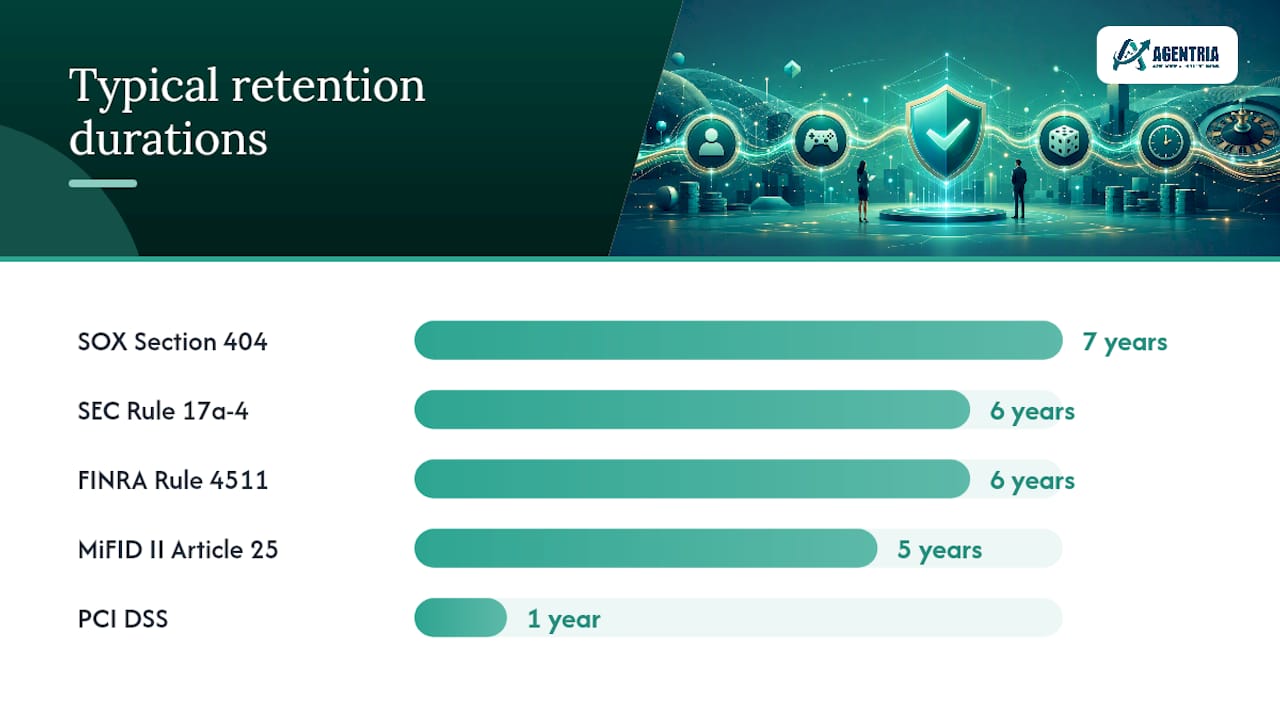
Healthcare and pharmaceutical environments answer to a different logic. FDA 21 CFR Part 11 requires that audit trails be secure, computer-generated, and time-stamped, and critically, that they never obscure previously recorded information. Retention here is tied to the underlying record’s own lifecycle rather than a fixed calendar figure. HIPAA runs alongside this with its own six-year minimum for certain documentation. PCI DSS, by contrast, sets a comparatively short one-year retention for most log data, with at least three months immediately available for analysis.
iGaming regulators have sharpened their focus recently. The Malta Gaming Authority’s 2024 annual report documents 13 compliance audits conducted that year, with a clear push toward more detailed licensee documentation, including player communication records.
| Framework | Typical retention | Accessibility note |
|---|---|---|
| SOX Section 404 | 7 years | Full record retention for audit-relevant financials |
| SEC Rule 17a-4 | 6 years | First 2 years immediately accessible |
| FINRA Rule 4511 | 6 years | Indexed and retrievable on demand |
| MiFID II Article 25 | 5 years | Client communications and transaction records |
| FDA 21 CFR Part 11 | Life of the record | Trail persists as long as underlying data |
| PCI DSS | 1 year | 3 months immediately available |
Build a regulatory exposure inventory before anything else. List every data category your systems touch, tag each one against every framework that could apply, and apply the longest retention and strictest accessibility rule that surfaces. Overlap is common, and the safe default is always the stricter obligation.
Immutability and the technical controls auditors actually accept
Mutable database tables are the single biggest structural weakness in most audit programmes, because any row that can be edited or deleted after the fact is a row an auditor cannot trust, as seen in examples like the Cardano Casino admin dashboard. If a support engineer with database access can quietly correct a timestamp, the entire log’s evidentiary value falls apart, regardless of how detailed the fields are.
Regulators increasingly expect true write-once characteristics rather than mere tamper-evidence. SEC Rule 17a-4’s explanatory material explicitly requires WORM (write once, read many) storage, and that expectation has become the practical baseline auditors look for across financial and increasingly non-financial sectors too. Cloud object storage with a compliance-mode lock, such as S3 Object Lock, satisfies this directly: once written, a record cannot be altered or deleted until its retention window expires, not even by an account administrator.
Cryptographic integrity adds a second, independent layer. Hash chaining, typically using SHA-256, links each log entry to the hash of the one before it, so any retroactive alteration breaks the chain and becomes mathematically detectable. Storing those hashes in a separate repository from the logs themselves, an approach widely recommended in regulated-industry audit trail design, means an attacker who compromises the primary log store still cannot forge a convincing history without also breaching the independent hash store.
Architecture choices worth building around:
- Append-only log services or write-once archives as the primary audit store, never a standard relational table with UPDATE/DELETE permissions
- Cloud object lock in compliance mode for long-term retention that even administrators cannot override
- Hash chaining with hashes mirrored to a separate, independently secured repository
- Synchronous writes to the audit store before an API call returns success, closing the window where an action happens but is not yet logged
That last point deserves particular attention. Writing audit records synchronously, before the triggering action is confirmed to the user, removes the gap where a system crash or network failure could let an action occur with no trace of it. When synchronous writes are genuinely impractical at scale, durable local buffers with immediate replication into immutable storage narrow that exposure considerably, provided replication lag is actively monitored rather than assumed.
Pro Tip: If your audit pipeline runs asynchronously for performance reasons, put a monitoring alert on queue depth and replication lag specifically. A silent backlog of unwritten audit events is invisible until a regulator asks for a record that technically exists in application memory but never made it to permanent storage.
Async or batched logging pipelines introduce their own risk even without a crash: clock skew between the application server and the logging service can shift a timestamp by seconds or minutes, which is enough to scramble event ordering in a dispute over exactly what happened first.
Building a compliance audit trail programme that holds up
A defensible audit trail is a governance exercise as much as an engineering one. Systems fail audits far more often because nobody owns the process than because the underlying technology was inadequate.
- Assign named owners. A compliance lead sets policy and retention requirements. A data steward tracks which systems generate which records. An engineering steward owns the technical implementation and its testing. Name a specific auditor contact who fields regulator requests, so nobody scrambles to figure out who answers the phone during an actual inspection.
- Map policy to retention practically. Translate each regulatory obligation from your exposure inventory into concrete system configuration, retention windows, legal hold triggers, and export templates that are ready before they are needed, not built in a panic once a subpoena arrives.
- Write the operational runbook. Document how to run an indexed export by user, date range, or document ID, how quickly that export can be produced, and how audit logs themselves get backed up and recovered in a disaster recovery scenario. A log that cannot survive its own system’s outage is not much of a record.
- Validate continuously, not just at go-live. Build audit trail test cases into your standard release validation process, so a code change cannot ship without confirming the logging still fires correctly. Schedule periodic integrity checks, verifying hash chains and spot-checking timestamp synchronisation, rather than waiting for a regulator to find the gap first.
Pro Tip: Run a “regulator request” fire drill twice a year: ask your team to produce a full export for a specific user over a specific 90-day window, and time how long it takes. If it takes days rather than minutes, your export tooling needs work before your next real audit does the timing for you.
Retention mapping and legal holds deserve particular discipline. A legal hold that pauses your normal retention schedule for one investigation must not accidentally purge unrelated records sitting in the same table, which is a genuine risk with poorly segmented storage.
Auditable communications: what iGaming platforms must log at message level
Regulated player communications carry the same evidentiary weight as any financial transaction record, and iGaming operators increasingly get judged on whether they can reconstruct exactly what a player was told and why. Communications-heavy regulated environments have a particular obligation: versioning the message template and policy snapshot at the moment of sending is critical for reconstructing disputes months or years later, when the current template has since changed.
A defensible message-level audit trail needs to capture:
- The full message body as sent, not a reference to a template that may later be edited
- Template ID and template version number, so the exact wording used at send time can be reproduced
- A snapshot of the responsible gambling or communications policy in force at that moment
- Channel used (email, live chat, SMS, Telegram), recipient ID, and a unique message ID
- The reviewer ID of whoever approved the message, and if AI-assisted, the model version and prompt reference used to generate it
Every message record needs to link back to the triggering event, whether that is a deposit threshold alert, a self-exclusion request, or a VIP escalation, and forward to the player account itself. Without that link, a regulator asking “why was this player sent this message” gets a message with no context, which is functionally useless as evidence.
Retention for communications evidence should follow the same regulatory exposure inventory logic as financial records. A jurisdiction with a five-year records requirement for player interactions means five years of fully exportable, readable message history, not five years of raw data sitting in a format nobody can query without engineering help.
Where audit trails fail: red flags examiners spot immediately
Certain failure patterns show up so consistently in audits that regulators have effectively been trained to look for them first.
Mutable tables and administrator edits are the fastest way to a critical finding. If an audit log table permits UPDATE or DELETE statements, or if a system administrator can silently correct a “mistake” in a historical entry, the entire log loses evidentiary standing. Remediation means migrating to append-only storage, and revoking write/delete permissions from every account, including your own senior engineers.
Batched or asynchronous logging creates gaps that are hard to see until something goes wrong inside them. A queue that processes audit events every five minutes looks fine until a server crashes at minute four, and that five minutes of activity simply never gets recorded. Mitigation means synchronous writes where feasible, and where not, durable buffers with active lag monitoring rather than a fire-and-forget queue.
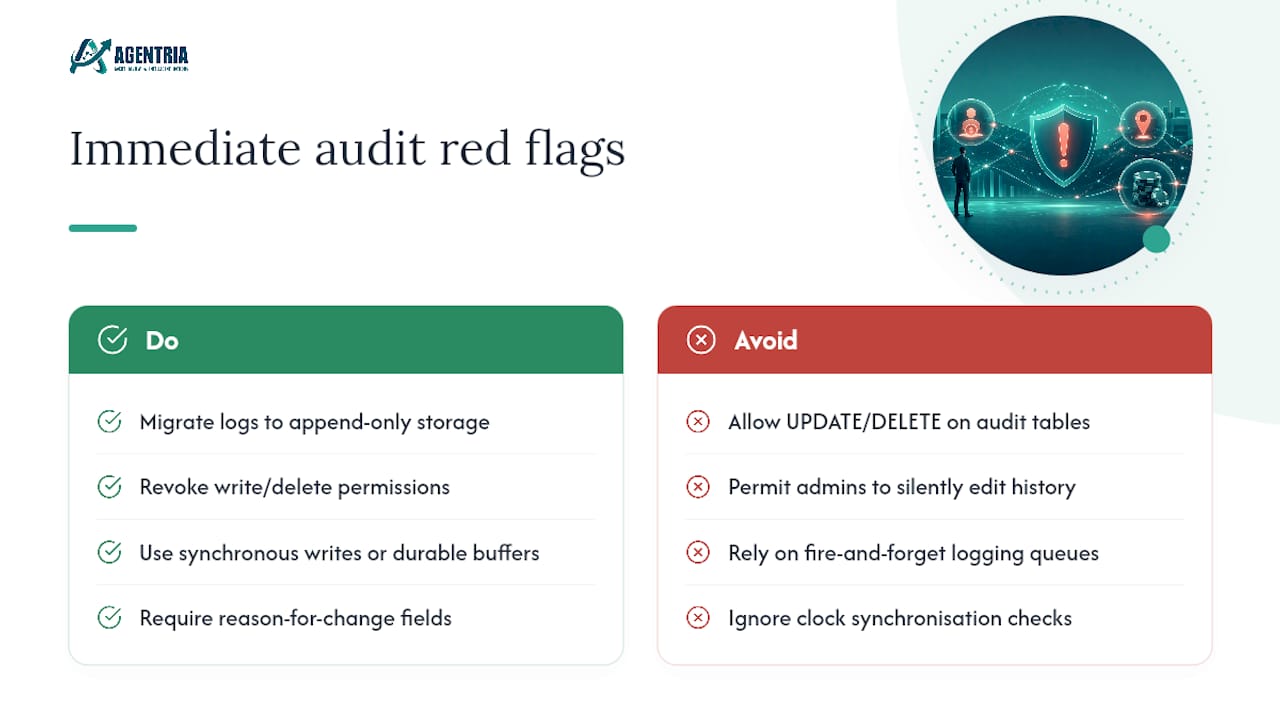
Clock skew between systems is a quieter but equally damaging problem. Two servers logging the same transaction eight seconds apart, purely because their clocks drifted, can make a sequence of events look reordered or contradictory during a dispute. Network Time Protocol synchronisation across your entire estate, checked regularly rather than configured once and forgotten, closes this gap.
Missing reason-for-change fields turn a complete-looking log into an incomplete one the moment an auditor asks “why.” A log with a before-value, an after-value, and no explanation invites the assumption of concealment rather than error.
Storing audit logs in mutable database tables is a recurring failure point identified in SEC rulemaking discussions, and write-once storage is the recommended remedy specifically because it removes the human temptation to “fix” a record after the fact.
Queryability matters more than most teams realise until a regulator sets a deadline. A log that technically contains the right data but takes engineering three days to extract and format is a log that fails the accessibility test built into rules like FINRA 4511, even if the underlying record is perfectly accurate.
A practical audit-readiness checklist before your next review
Run through these before a regulator request lands, not after.
Technical checks
- Confirm object lock or equivalent write-once storage is active on the primary audit log store
- Verify hash chain integrity end to end, including that hashes are mirrored to an independent repository
- Test the synchronous write path under load to confirm no events silently drop during peak traffic
Operational checks 4. Confirm retention schedules are configured per data category against your regulatory exposure inventory 5. Run a live legal-hold test to confirm it suspends deletion without disrupting unrelated records 6. Generate a sample export using your standard template and confirm a non-technical reviewer can read it unaided
Governance checks 7. Confirm named owners exist for compliance, data stewardship, and engineering, and that each knows their role 8. Review evidence from your last periodic integrity test and confirm findings were actioned, not just logged 9. Document the review cadence itself, so the next audit shows a pattern of checking, not a one-off scramble
| Checklist area | Pass criterion |
|---|---|
| Storage immutability | Object lock or WORM active, verified by test deletion attempt |
| Hash integrity | Chain verified, independent hash store confirmed |
| Retention mapping | Every data category tagged to its longest applicable rule |
| Export readiness | Sample export produced and readable within a defined time target |
| Ownership | Named individuals for compliance, data, engineering, and auditor liaison |
Publisher perspective: what regulated communications actually demand
Most compliance guidance treats audit trails as a records problem. In regulated player communications, it is a decision-quality problem wearing a records costume. The interesting failure mode is not that operators lose messages. It is that they keep the message but lose the context: which policy version applied, who approved the wording, whether a human or a model drafted it first.
Agentria was built around that distinction. It combines multiple AI providers with mandatory human review before any AI-generated reply reaches a player, and every one of those decisions gets logged: reviewer ID, template version, the policy snapshot in force at send time. That is not a compliance feature bolted onto a support tool. It is what makes an AI-assisted response defensible in front of a regulator like the Malta Gaming Authority in the first place, because the record shows a human made the call, and shows what they were working from when they made it.
The gap between “we have logs” and “we have reconstructable decisions” is where most audit programmes actually fail, communications included.
— AGENTRIA
Get audit-ready communications without building the infrastructure yourself
Agentria gives operators the compliance record without the internal build. Every AI-generated player message runs through human review before it ever reaches a player, and every step, template version, reviewer ID, policy snapshot, and channel, gets captured automatically as audit-ready messaging evidence.

That means when an auditor or a regulator like the MGA asks for the full history behind a specific player interaction, you are exporting a record, not reconstructing one from scattered logs across email, live chat, SMS, and Telegram. The platform’s full feature set covers VIP queue management and responsible gambling detection alongside the audit trail itself, so compliance and player experience run on the same evidence base rather than two disconnected systems.
If your current setup makes you nervous about what an export would actually look like under pressure, that is worth testing before a regulator does it for you. Book a demo and see what a fully reconstructable message history looks like in practice.
Where to check the primary rules yourself
Every claim about retention periods and technical requirements in this article traces back to a primary regulatory source, and it is worth reading the originals directly rather than relying on secondary summaries.
- SEC retention rules and related guidance sets out the record retention expectations tied to SOX audits and reviews.
- SEC Rule 17a-4 explanatory material covers broker-dealer record retention and the WORM storage requirement.
- FINRA Rule 4511 governs books and records accessibility for member firms.
- NIST’s glossary definition of an audit trail provides the technical baseline referenced across multiple frameworks.
- Malta Gaming Authority’s 2024 annual report documents current enforcement priorities for iGaming licensees.
Sources
- U.S. Securities and Exchange Commission - retention rules and related guidance
- Malta Gaming Authority — 2024 annual report and financial statements
- NIST glossary: audit trail
- FINRA Rule 4511 — Books and Records
Recommended
See AGENTRIA on your support workflow
Book a walkthrough tailored to your brands, channels, and compliance requirements.