
Human-in-the-loop AI in a casino support context means AI-generated replies get vetted and approved by human reviewers before they reach players, so every answer is accurate, on-brand, and compliant with safer-gambling rules. If you’re evaluating this for your operation, the next step is narrow: run a two-week pilot on three high-volume, money-impacting intents (withdrawal status, bonus eligibility, KYC state) using retrieval-augmented generation (RAG), live account state calls, and mandatory human approval gating. Platforms like AGENTRIA build this exact model, with append-only decision logs that record every AI decision, the model used, and the context sources behind it — the evidence base a compliance team needs when a regulator asks.
- Definition: AI drafts, humans approve, every decision gets logged.
- First move: pilot three intents, not your whole queue.
- Target: measurable First Contact Resolution (FCR) gains without a spike in compliance incidents.
Pro Tip: Pick intents where a wrong answer costs real money. If your pilot only tests low-stakes FAQ traffic, you’ll never learn whether your review workflow can handle the cases that actually create disputes.
Key Takeaways
Human-in-the-loop AI works in iGaming support only when clause-indexed retrieval, live state calls, and mandatory human approval combine into one auditable workflow.
| Point | Details |
|---|---|
| Start with a narrow pilot | Test three high-volume, money-impacting intents for two weeks before wider rollout. |
| Gate money-impacting replies | Require human approval and a live state call before any withdrawal or bonus answer sends. |
| Track dispute-driven metrics | Use hallucination rate and compliance incidents, not just speed, to judge readiness. |
| Confirm write-API access early | Many legacy PAM and CRM systems are read-only and block full automation until upgraded. |
| Evaluate vendors on audit depth | AGENTRIA pairs configurable human approval gating with per-message decision logs recording the model, confidence and knowledge-base sources used, across chat, email, SMS and Telegram. |
Table of Contents
- What Does Human-in-the-Loop AI Look Like in Live Support?
- What Benefits Justify the Human Review Overhead?
- What Compliance Safeguards Does HITL Need Before Launch?
- What’s the Technical and Operational Implementation Checklist?
- Which KPIs Should You Track, and What Improvement Is Realistic?
- How Should You Phase the Rollout From Pilot to Production?
- How Does AGENTRIA Put Human-in-the-Loop Into Practice?
- How Should You Evaluate a Human-in-the-Loop Vendor?
- Frequently Asked Questions
- Sources
What Does Human-in-the-Loop AI Look Like in Live Support?
In practice, it’s a five-step handoff, not a single tool. A player asks a question, the system retrieves relevant policy content through RAG, then calls live account state (balance, KYC status, bonus flags) before drafting a reply. A human reviewer checks that draft, edits or approves it, and only then does it reach the player, with every step written to an audit log.
Several roles touch that pipeline:
- CSR reviewer approves or edits routine drafts.
- Compliance reviewer signs off on anything touching payouts, self-exclusion, or dispute language.
- Escalation officer takes flagged cases the model can’t resolve confidently.
- SRE/engineer owns uptime for the RAG index and state-call endpoints.
- Data ops maintains the policy corpus and clause mapping.
The difference between account-agnostic and account-specific answers matters here. RAG alone can explain a bonus policy in general terms, but only a tool call into live account state can tell a specific player whether their withdrawal cleared.
Pro Tip: If your AI can answer a policy question but not “where’s MY money,” you’ve built a FAQ bot, not a support system.
What Benefits Justify the Human Review Overhead?
The overhead pays for itself in speed and defensibility, not just risk reduction. Operators running AI plus human review report faster resolution and higher CSAT because automation clears repetitive tickets, freeing reviewers for the complex cases that actually need judgment.
Here’s where the gains show up:
- Faster time-to-resolution on account-specific queries, since the AI draft arrives pre-populated with live state.
- Policy accuracy and auditability, because every money-impacting answer carries a clause ID back to the exact policy text it relied on.
- Safer-gambling detection that flags risk signals for human judgment rather than letting a bot make the call.
- VIP continuity, since a human reviewer can preserve tone and history for high-value players an AI alone would flatten.
- Multilingual scale without hiring a native-language reviewer for every market.
Each benefit ties to a control you can actually measure: First Contact Resolution (FCR), CSAT, time-to-resolution, cost per ticket, and compliance incident count. The real payoff shows up in the incident count column more than the speed metrics, because a defensible audit trail is what keeps a regulator conversation short instead of long.
What Compliance Safeguards Does HITL Need Before Launch?
A compliance team should treat this as a pre-launch gate, not a nice-to-have. Before any HITL system touches real player traffic, confirm these controls exist:
- Clause-indexed RAG so every policy-based answer traces to a specific clause, not a paraphrase.
- Mandatory state API calls for any reply involving money, eligibility, or account status.
- Human approval gates on high-risk intents: withdrawals, disputes, self-exclusion, AML flags.
- Immutable decision logs covering the retrieved clause, the state call, the human edit, and the timestamp.
- Jurisdiction gating so responses reflect the rules of the license under which that player is registered.
- Data minimization and PCI-safe logging so sensitive payment data never sits in plain text inside a transcript.
Certain triggers should force escalation automatically, no exceptions: AML flags, self-exclusion attempts, dispute language, or a clause retrieval that comes back ambiguous. Industry panels of iGaming support leads consistently land on the same principle: AI should catch risk and hand a fully documented case to a human, not attempt the sensitive call itself.
Write permissions are the quiet dealbreaker. Many legacy PAM and CRM platforms only expose read access, which means an agent can detect that a withdrawal is stuck but can’t actually release it. Every automation plan needs an inventory of which systems are read-only today.
Pro Tip: Before you sign a vendor contract, ask your engineering team to confirm which back-office systems currently accept write calls. If the answer is “none,” budget time for API permission work, not just AI configuration.
What’s the Technical and Operational Implementation Checklist?
Getting from concept to production means lining up architecture, roles, and integrations in that order.
- Split the retrieval index into a policy corpus (terms, bonus rules, KYC requirements) and an operations corpus (FAQs, macros, known issues) so the model doesn’t blend the two.
- Build tool-calling endpoints for the handful of queries that actually need live data:
get_withdrawal_status,get_kyc_state,get_bonus_assignment,create_ticket. - Enforce a response schema for every draft: intent, required state calls, retrieved clause IDs, answer, escalation flag. This structured pattern reduces hallucination far more reliably than prompt tuning alone.
- Set up role-based access control so reviewers only see the queue tier they’re cleared for.
- Wire integrations to PAM, CRM, and ticketing systems, and flag which are read-only today, since write-capable APIs are what unlock real automation rather than partial detection.
Pro Tip: Name one accountable owner for agent behavior before launch, not after the first incident. “The AI did it” isn’t an answer a regulator, or your CFO, will accept.
Which KPIs Should You Track, and What Improvement Is Realistic?
Five metrics tell you whether the deployment is actually working, beyond gut feel from spot-checking transcripts.
| KPI | What it measures | Expected direction |
|---|---|---|
| First Contact Resolution | Percent of tickets closed without follow-up | Meaningful improvement over baseline |
| CSAT | Player satisfaction score post-interaction | Modest, steady gains as accuracy improves |
| Time-to-resolution | Minutes from query to closed ticket | Noticeable reduction on high-volume intents |
| Hallucination rate | Policy mismatches per sampled batch | Should trend toward zero with clause-ID checks |
| Compliance incident count | Escalations mishandled or missed | Should stay flat or fall as gating tightens |
Use dispute transcripts and exception logs as your regression test set. Every time a player disputes an answer, that transcript becomes a training and QA input that either exposes a gap in the clause-linked policy layer or a reviewer error worth coaching on.
How Should You Phase the Rollout From Pilot to Production?
Move in three deliberate phases rather than flipping a switch on your whole support queue.
- Weeks 1 to 8, agent-assisted: AI drafts every reply, humans approve 100% of them. No autonomous sends.
- Weeks 8 to 16, low-stakes autonomy: Let the AI auto-send only on intents with near-zero dispute history (FAQ-style questions), while money-impacting intents stay human-gated.
- Week 16 onward, higher-stakes automation: Expand autonomy carefully, always backed by full audit infrastructure and documented override paths.
Before Phase 1 even starts, lock down your pilot checklist: three target intents, defined success metrics, a dispute-sampling plan, dedicated reviewer staffing, and a weekly QA cadence.
- Hallucination rate must sit under your defined threshold before advancing a phase.
- Clause retrieval confidence must clear its threshold on sampled queries.
- Reviewer SLA compliance must hold steady, not just on average but at the tail end.
- Audit logs must be complete, with no gaps between draft, review, and send.
Pro Tip: Build your rollback criteria before launch, not during a crisis. If you don’t know in advance what triggers a phase reversal, you’ll improvise one under pressure, and that’s how bad calls get made.
How Does AGENTRIA Put Human-in-the-Loop Into Practice?
Picture a player messaging about a stuck withdrawal. AGENTRIA’s AI drafts a reply using the player’s synced account and banking state alongside the brand’s knowledge-base policy articles for withdrawal processing times. A human reviewer sees the draft alongside the AI’s reasoning and the exact context that fed it before approving, editing, or escalating. The whole exchange, including the context sources that fed the draft and the reviewer’s action, writes to an append-only audit trail.
That workflow runs the same way across chat, email, SMS, and Telegram, with configurable escalation rules for anything touching KYC, disputes, or self-exclusion, and multilingual handling so the review step doesn’t become a bottleneck in non-English markets.
- Human approval gating you configure per brand, up to sign off on every AI-generated reply before it reaches a player.
- Append-only audit trail tying each answer to its decision reason, model, confidence score and the context sources it drew on.
- Configurable escalation rules for high-risk or ambiguous intents.
- Multi-channel coverage across chat, email, SMS, and Telegram from one dashboard.
When a dispute lands weeks later, the operator doesn’t need to reconstruct what happened. The draft, the model and confidence behind it, the context it drew on and the reviewer’s action are already logged, which turns a “he said, she said” argument into a two-minute lookup.
Pro Tip: Ask any vendor, including AGENTRIA, to show you a live dispute lookup during the demo. If they can’t pull the clause and state call in under a minute, the audit trail isn’t as complete as the pitch deck suggests.
What Operations Leads Actually Struggle With
Calibrating escalation thresholds is harder than picking a model. Get the threshold too tight and reviewers drown in tickets that didn’t need them; too loose, and risky cases slip through. Training reviewers to treat the AI’s draft as a colleague’s suggestion, not gospel or noise, takes longer than any technical rollout. The dispute-driven feedback loop, where a bad outcome retrains both the model and the reviewer’s judgment, is where the real improvement happens over time.
How Should You Evaluate a Human-in-the-Loop Vendor?
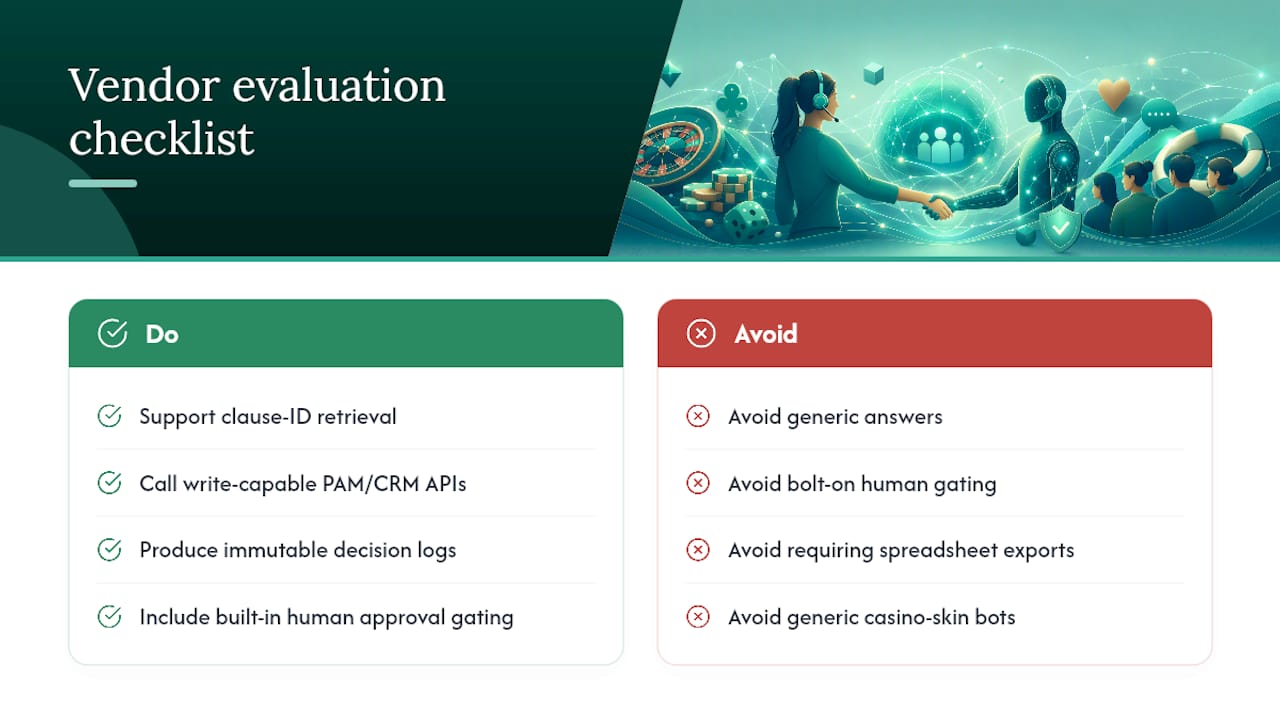
Before you sign anything, run a vendor through this checklist: does it support clause-ID retrieval, not just generic answers? Can it call write-capable APIs into your PAM and CRM, or only read status? Does it produce an immutable decision log for every message? Is human approval gating built in, not bolted on? Does it cover the channels your players actually use, and does the reporting dashboard give you FCR, CSAT, and incident counts without a spreadsheet export?
AGENTRIA covers the core of this checklist: multi-provider AI drafting, per-brand human review before send, an append-only per-message decision log, and KPIs like AI handle rate, time-to-first-response and escalation accuracy — an audit trail designed for regulated markets rather than retrofitted onto a generic chatbot. Deploying AI support in iGaming demands real customization for compliance and VIP handling, not a generic bot with a casino skin, and that’s the gap AGENTRIA is built to close.
If this matches what your compliance and operations teams need, the next step is straightforward: book a demo and walk through a live withdrawal or KYC scenario with your own policy documents.
Frequently Asked Questions
What is human-in-the-loop AI in the context of online casino support? It’s a workflow where AI drafts replies to player queries and a human reviewer approves, edits, or rejects each one before it reaches the player, with every decision logged for compliance.
How is human-in-the-loop AI different from a standard chatbot? A standard chatbot sends replies automatically. Human-in-the-loop AI inserts a mandatory review step for anything money-related, risky, or ambiguous, backed by an audit trail.
How does human-in-the-loop AI work technically? The system retrieves policy content through RAG, calls live account state through dedicated APIs, drafts a reply, routes it to a human reviewer, and logs the clause IDs and state calls used.
What’s the fastest way to pilot this without disrupting existing support?
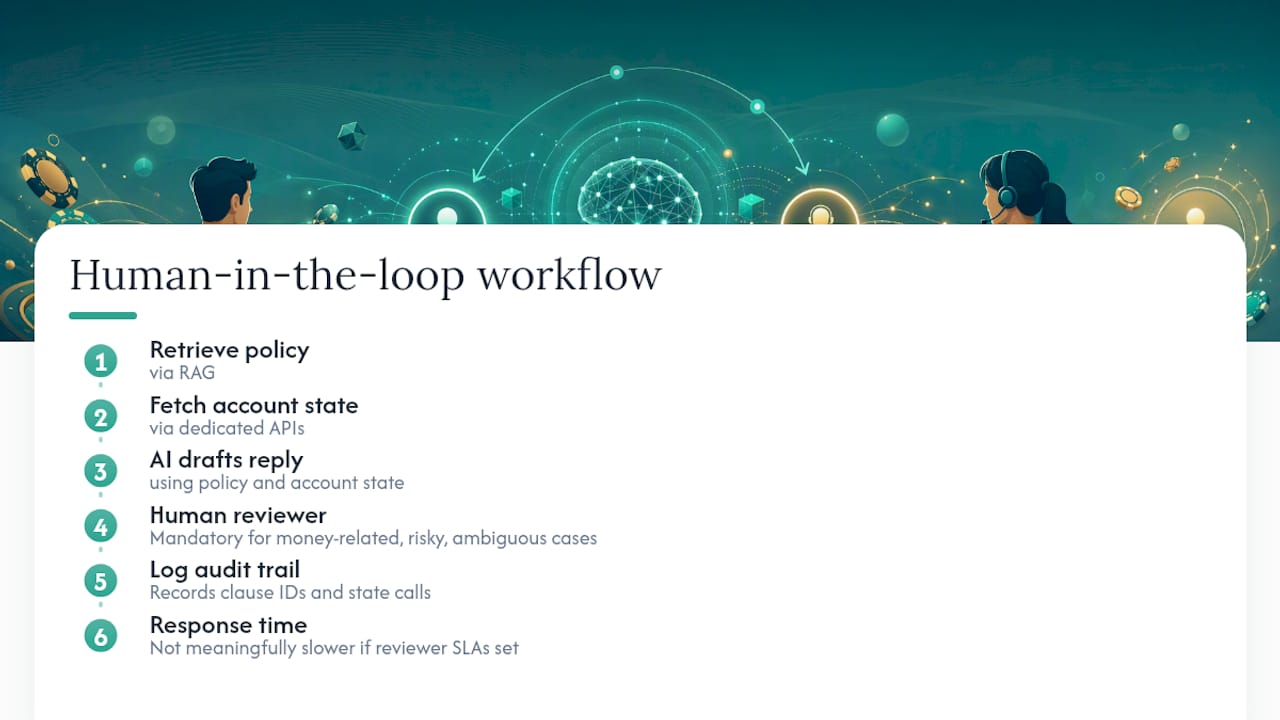
Does human-in-the-loop AI slow down response times compared to full automation? Not meaningfully, once reviewer SLAs are set correctly. The AI draft removes most of the research time, so a reviewer’s job is mainly confirming accuracy rather than writing from scratch.
Sources
Recommended
See AGENTRIA on your support workflow
Book a walkthrough tailored to your brands, channels, and compliance requirements.