
First contact resolution measures whether a customer’s issue gets fully solved during their initial interaction, with no callback, follow-up email, or repeat ticket required. It matters because it’s one of the tightest predictors of customer satisfaction available to a support operation, and it’s directly tied to cost. Every contact that resolves the first time is a contact your team never has to touch again.
Most operations should be targeting a first contact resolution (FCR) rate that is generally considered solid performance, though the right number depends heavily on channel and issue complexity. A billing question resolved by chat behaves very differently than a multi-system technical fault worked over the phone.
- FCR uplift correlates strongly with CSAT gains across the contact center industry
- Every resolved-on-first-contact case eliminates the cost of a second, third, or fourth touch
- Chasing FCR without a guardrail metric like reopen rate can hide a team that’s just closing tickets fast, not well
Key Takeaways
First contact resolution rises fastest when routing, knowledge access, and agent permissions improve together, and it stays trustworthy only when reopen rate and repeat-contact rate are tracked alongside it.
| Point | Details |
|---|---|
| Define resolution first | Write down what counts as a resolved contact before calculating any FCR number. |
| Choose your window deliberately | A callback window of one business hour suits most channels; longer windows catch more delayed complaints. |
| Watch the guardrails | Keep reopen rate low and repeat-contact rate controlled to catch gamed FCR numbers. |
| Pilot AI narrowly | Track AI-resolved and human-resolved CSAT separately before scaling automation. |
| Consider human-in-loop platforms | Agentria pairs AI drafting with a review gate you configure for regulated iGaming support, preserving audit trails while lifting resolution speed. |
Table of Contents
- What Counts as First Contact Resolution?
- Why Does First Contact Resolution Matter for CSAT and Cost?
- How Do You Calculate First Contact Resolution?
- What Is a Good First Contact Resolution Rate?
- What Are the Common Pitfalls in Measuring FCR?
- How Can You Improve First Contact Resolution?
- How Should You Segment and Report First Contact Resolution?
- How Does AI Change First Contact Resolution?
- How Do You Run a Pilot to Improve FCR?
- Sources
What Counts as First Contact Resolution?
The customer’s definition is simple: their problem got fixed the first time they reached out, full stop. Operational definitions get murkier, and that gap is where most measurement disputes start.
First call resolution is the voice-only ancestor of this metric, born in phone-only call centers decades ago. First contact resolution expanded that idea across every channel, chat, email, SMS, social, and self-service, because customers now bounce between them freely and expect the same standard everywhere.
A few edge cases trip up teams constantly:
- A warm transfer between two agents on the same call generally still counts as one contact, since the customer didn’t have to reach out again.
- A partial fix, where the symptom disappears but the root cause is untouched, should not count as resolved even if the agent closes the ticket.
- A multi-message chat thread that spans several minutes is one contact; the same issue reopened as a new ticket two days later is not.
Get this definition written down and shared across your team before you calculate anything. Without it, your FCR number means whatever the person building the report wants it to mean.
Why Does First Contact Resolution Matter for CSAT and Cost?
Support leaders track dozens of metrics, but FCR earns its spot at the top because it moves two things operators actually care about: satisfaction scores and operating cost.
The relationship runs in both directions. Customers who get resolved on the first try report meaningfully higher satisfaction than those who need a second contact, and every repeat contact adds direct labor cost, since your team is essentially working the same problem twice.
Here’s the trap: a high FCR number by itself doesn’t guarantee good outcomes. Teams under pressure to hit an FCR target can close tickets prematurely, discourage customers from calling back, or quietly reclassify unresolved issues as resolved. That’s why FCR should never travel alone. It needs companion metrics, which we’ll get to shortly, or the number becomes a target that management chases instead of a signal that reflects reality.
How Do You Calculate First Contact Resolution?
The core formula is straightforward:
FCR = (Contacts resolved on first interaction ÷ Total contacts) × 100
The complexity isn’t in the math, it’s in defining “resolved” and choosing your measurement method.
- Operational (internal) measurement pulls from agent logs and case management systems, flagging a contact as first-contact-resolved if no repeat contact on the same issue arrives within a set window.
- Customer-stated measurement asks the customer directly, usually via a post-interaction survey question like “Was your issue fully resolved today?”
- Blended measurement runs both in parallel and reports the gap between them, which tells you a lot about agent behavior and survey bias alike.
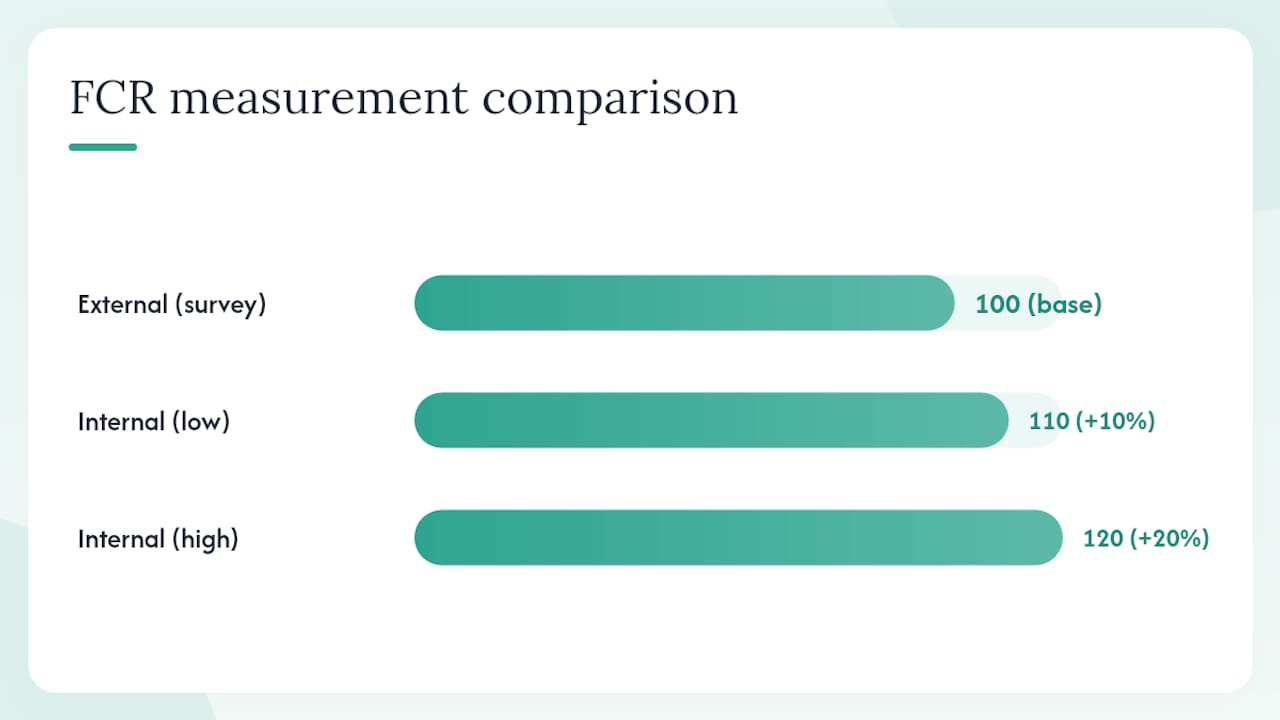
Internal, repeat-call-window methods commonly overstate FCR by 10% to 20% compared with external post-call survey measures, largely because customers who don’t call back aren’t necessarily satisfied. Some just gave up.
Your callback window changes the number substantially. Shorter windows suit live chat and simple account fixes for faster reporting but may miss delayed complaints; medium windows suit phone support and standard tickets; longer windows best capture technical or billing disputes but delay reporting.
MetricNet’s guidance treats email and web tickets as resolved if fixed within one business hour, an attempt to approximate phone-era standards for asynchronous channels. Whatever window you choose, exclude known bugs awaiting a fix, contacts requiring a scheduled follow-up by design, and cases pending missing customer information, none of those are FCR failures. They’re a different category entirely.
What Is a Good First Contact Resolution Rate?
Scores in the range considered solid performance and scores above that are often seen as exemplary, usually for narrow, well-documented issue types.
Channel and complexity shift these numbers more than most managers expect:
- Simple account questions handled by chat can push well above 85%, since the resolution paths are short and scripted.
- Complex technical or billing disputes routed through phone or email often sit closer to 60%, because they involve multiple systems or approvals.
- New product launches temporarily depress FCR across every channel until agents and knowledge bases catch up.
Recent AI benchmarking found an overall AI resolution rate of 68% as of March 2026, with top-quartile teams reaching 78% to 85%. That range is a useful anchor if you’re layering automation into your support model. Set your internal target in phases: baseline your current rate, pilot one improvement, then raise the target only after the pilot proves out in real numbers, not in a spreadsheet projection.
What Are the Common Pitfalls in Measuring FCR?
FCR is easy to game, sometimes without anyone intending to. A few patterns show up again and again in contact centers under pressure to hit a number:
- Ticket splitting, where one customer issue gets logged as multiple separate contacts, artificially inflating the resolved count for each piece.
- Premature resolve, where an agent closes a case the moment the customer stops talking, not the moment the problem is actually fixed.
- Discouraging follow-ups, subtly steering customers away from calling back so the repeat contact never gets logged.
If your FCR rate looks unusually high, that’s often a red flag, not a win. It can mean your data window is too short to catch delayed complaints, or that agents have learned to close fast rather than close right.
Pro Tip: If your FCR jumps more than five points in a single reporting period with no process change behind it, audit the underlying tickets before you celebrate. That kind of jump almost always traces back to a definition change, not a performance change.
How Can You Improve First Contact Resolution?
Raising FCR isn’t one initiative, it’s a stack of smaller fixes that compound. Here’s the order that tends to produce results fastest:
- Start with your top five contact reasons. Root-cause each one and fix the underlying process, not just the symptom agents see.
- Fix routing first. Intent-based routing that gets a customer to the right specialist on the first attempt is one of the fastest, highest-yield levers available, because misrouted contacts almost never resolve on the first try.
- Upgrade the knowledge base. An agent can’t resolve what they can’t find. Surface the correct article directly on the agent’s desktop at the moment they need it, not buried three folders deep.
- Extend agent permissions. If a front-line agent has to escalate every refund over $50 or every account change, you’ve built a bottleneck into your own FCR ceiling. Widen the authority where risk allows it.
- Design warm transfers carefully. A transfer should preserve resolution credit when the customer’s issue still gets solved in that single continuous interaction, rather than penalizing the team for routing correctly.
- Build fallback flows with a next step, not an apology. When automation can’t fully resolve something, offering a warm transfer or a scheduled callback preserves trust far better than a generic “sorry, we can’t help with that.”
- Run weekly root-cause reviews. A short, recurring review of the week’s unresolved cases surfaces patterns faster than a quarterly audit ever will.
Pro Tip: Permissions and knowledge base fixes usually beat headcount increases for raising FCR. More agents doesn’t help if none of them can actually close the loop on the issue in front of them.
How Should You Segment and Report First Contact Resolution?
A single blended FCR number hides more than it reveals. Segment it by channel, issue type, team, and customer tier, and the real story starts to show up. Chat FCR and phone FCR almost never match, and VIP-tier issues often run more complex than standard-tier ones, which will drag a blended average down even when your VIP team is performing well.

Report FCR next to reopen rate and repeat-contact rate every time, never on its own. Contact center guidance on this point is consistent: define your repeat-contact window once, document it, and audit against it regularly rather than trusting the automated count blindly.
A practical audit cadence:
- Pull a random sample of roughly 50 tickets each quarter and manually verify the FCR classification against the actual ticket notes.
- Track how often the manual audit disagrees with the automated tag, that disagreement rate tells you how much to trust the dashboard.
- Document every definition and window choice in a shared change log, so a rate shift six months from now can be traced to a real process change instead of a silent measurement tweak.
How Does AI Change First Contact Resolution?
AI-assisted support can meaningfully lift FCR, but only with governance built in from day one. Databricks recommends piloting AI narrowly on a small set of high-volume, well-understood intents first, then tracking AI-resolved and human-resolved cases as two separate metrics rather than blending them into one number.
- Set a confidence threshold below which every AI-generated response routes automatically to a human for review before it reaches the customer.
- Track AI-resolved CSAT separately from human-resolved CSAT; if they converge, you have a real signal to scale.
- Keep compliance-sensitive categories, refunds, account verification, responsible gambling flags, under mandatory human review with a complete audit trail.
- Expand automation scope only after the pilot data holds up across at least one full reporting cycle.
Human review isn’t a temporary training-wheels phase. In regulated environments, it’s a permanent part of the architecture. As Fivetran’s guidance on AI-augmented support puts it, the human role shifts from writing every response to governing outcomes at scale.
Regulated operators can’t treat AI resolution as a black box. Every AI-generated reply that touches a compliance-sensitive category needs a documented review step and an auditable trail back to a human decision, not just a confidence score.
This is exactly the model Agentria applies for online casino support: AI drafts a response, a staff member reviews it whenever your settings call for review, and every decision gets logged for compliance review later. For operators in regulated iGaming markets, that structure isn’t optional overhead, it’s what makes automation usable in the first place.
How Do You Run a Pilot to Improve FCR?
A tight, six to eight week pilot beats a sprawling year-long rollout for validating any FCR intervention.
- Weeks 1 to 2: Define scope, pick two or three narrow intents, and baseline your current FCR, reopen rate, and CSAT for those specific intents.
- Weeks 3 to 4: Set success metrics, a specific FCR lift target, a CSAT floor, and a reopen rate ceiling you won’t cross.
- Weeks 5 to 6: Deploy the change with guardrails active, and if AI is involved, track its resolved cases separately from human-resolved ones.
- Weeks 7 to 8: Review the results, iterate the knowledge base or routing rules based on what failed, and decide whether to scale, adjust, or kill the pilot.
A practitioner’s note on getting FCR right
The first 90 days matter more than any dashboard redesign. Fix routing and knowledge access before touching agent scorecards, those two levers move FCR faster than almost anything else. Watch for metric gaming constantly, and weight customer-stated confirmation over internal no-repeat-call counts whenever the two disagree. The internal number will almost always look better than reality.
Raising resolution rates safely in a regulated market
Agentria gives online casino operators a way to raise resolution rates without trading away compliance control. You choose whether the AI sends anything unattended: hold every draft for review, or let the ones it scores as high confidence go straight out. That means faster answers on routine account, deposit, and bonus questions without giving up the oversight regulators expect, because anything escalated or below the bar still waits for a person.
That matters most in the categories where a fast wrong answer is worse than a slow right one: withdrawal disputes, verification issues, and responsible gambling flags that require a documented, auditable decision trail. Agentria’s omnichannel setup covers email, live chat, SMS, and Telegram from one dashboard, so resolution metrics like AI handle rate — which counts a player who comes back on the same thread within 48 hours against you — and time to first response stay visible across every channel a player might use, not just the one you happen to be watching closest.
If you’re weighing how to lift FCR without losing the human checkpoint your compliance team requires, book a demo and walk through how the review workflow applies to your specific contact volume and issue mix.
Sources
- AI customer service: strategy, agents, and solutions guide | Databricks Blog
- AI Customer Support Benchmark Report: March 2026 | Corebee
- First call resolution — Wikipedia
- What Is First Contact Resolution? Formula & Benchmarks | Helply
Recommended
See AGENTRIA on your support workflow
Book a walkthrough tailored to your brands, channels, and compliance requirements.