24/7 Virtual Support Personas With Audit Trails for iGaming Operators

Virtual support personas are configurable AI agent profiles, defined by tone, permissions, channel behaviour and compliance rules, that handle player communications for online casinos. The right approach pairs these personas with human-in-the-loop review and full audit trails, never full automation alone. Done properly, this cuts response times, protects regulatory standing, and gives operators a defensible record of every decision made on a player’s behalf.
TL;DR:
- Virtual support personas must be carefully configured with specific tone, permissions, and escalation rules to ensure compliance and effective player interactions.
- Proper design separates world-building from behavior, maintaining distinct personas for mass-market and VIP players to preserve authenticity and control.
- Human review and audit trails are essential for sensitive topics, with tasks like pre-send approval and supervisory queues to mitigate regulatory risks.
- Testing in staged phases and continuous monitoring of key metrics help detect drift, failures, or compliance issues before they lead to incidents.
- Over-automation on sensitive matters is a common pitfall, necessitating strict safeguards and real-time oversight to prevent regulatory violations or player distress.
Table of Contents
- What does “virtual support personas” mean in iGaming?
- Why virtual support personas matter to online casinos
- Core design components of an iGaming support persona
- Human-in-the-loop, audit trails and escalation design
- Implementation checklist: configure, test and deploy safely
- Measuring persona performance and safety
- Common pitfalls and how to mitigate them
- How Agentria operationalises persona safety
- See how Agentria fits your player support setup
- Sources
What does “virtual support personas” mean in iGaming?
Drop the vague idea of a chatbot with a name. In this context, a virtual support persona is a configuration file with teeth: it sets the tone a player hears (formal, casual, VIP-warm), the permissions the agent can act on (view balance, not authorise withdrawals), the channels it operates across, and the compliance rules that override everything else when a conversation turns risky.
This is not the same as a marketing persona built from customer research, and it’s not a branded avatar with a face and backstory. Those are UX or marketing constructs. An iGaming support persona is an operational control layer sitting inside your support stack, used for frontline triage, VIP account handling, and the specific moments where a responsible gambling (RG) flag needs to interrupt a normal conversation. Get the definition wrong and you’ll build the wrong governance around it.
Why virtual support personas matter to online casinos
Speed changes outcomes. A player who hits a technical snag at 2am and waits six hours for an email reply is a player who has probably already opened a competitor’s site. Configurable AI personas answer game rules, account questions and technical queries around the clock, closing that gap entirely. Industry reporting frames this as the core value proposition: personalised AI service that mirrors the attentiveness of land-based casino staff, available at any hour, tends to lift both retention and lifetime value.
Deflection is where the cost savings live. Every routine query a persona resolves without human intervention frees your support team for the conversations that actually need a person, VIP escalations, disputes, RG concerns.
Personalisation compounds this. A persona that remembers a VIP player’s preferred games and greets them accordingly replicates the kind of attentive service land-based casinos have always relied on, which is a genuine lever for lifetime value, not just a nicety.
Core design components of an iGaming support persona
Four fields decide whether a persona helps you or exposes you. Get these wrong and no amount of clever prompting fixes it downstream.
- Tone and style variants. A persona speaking to a casual weekend player should sound different from one handling a high-value VIP. Map tone directly to player segment, not to a single house voice.
- Permissions. Define exactly what the persona can see and do: read-only balance access is safe by default; anything touching withdrawals, KYC documents or account closure needs a human in the loop before action.
- Channel behaviour. The persona should behave consistently whether a player messages via live chat, email, SMS or Telegram, and critically, context from one channel must persist if the player switches to another mid-conversation.
- Escalation triggers and suppression rules. Certain phrases, patterns or account states (self-exclusion requests, distress language, repeated deposit attempts after a loss) must route instantly to trained staff, never to a scripted AI response.
Research into persona generation backs up why the design step matters beyond compliance. Studies on procedural character-building show that separating world-building from behavioural-building produces more diverse, controllable personas, avoiding the generic, homogenised “assistant voice” that makes every interaction feel identical regardless of segment. For an operator running personas across mass-market and VIP tiers simultaneously, that distinction is what keeps the two feeling genuinely different to the player.
Human-in-the-loop, audit trails and escalation design
Full automation on sensitive gambling topics is a regulatory liability, not an efficiency win. Every credible operational model treats AI drafting and human sign-off as two separate steps.
Three review patterns cover most operator needs:
- Pre-send review for anything touching money, account status or RG signals, a human reads and approves before the player sees it.
- Supervisory queues for VIP or high-value accounts, where a senior agent oversees the persona’s conversation in near real time.
- Sampling review for routine, low-risk queries, where a percentage of AI-handled conversations gets audited after the fact rather than before.
Regulators expect a paper trail that proves which pattern applied and when. A minimal audit record should capture: timestamp, persona ID, the player’s input, the AI’s draft response, the reviewing staff member’s ID (where review occurred), the final message sent, and an escalation flag with its reason. Miss any of these and you can’t reconstruct a decision when a regulator or a player disputes it later.
Pro Tip: Build suppression logic around account state, not just keywords. A player who has just set a deposit limit shouldn’t receive a promotional nudge an hour later, regardless of how the request was phrased.
Industry guidance on protecting people who gamble is consistent on one point: RG queries and self-exclusion signals should never be fully answered by AI. They go to trained staff, always.
Implementation checklist: configure, test and deploy safely
Rolling out a new persona set works best as a sequence, not a single launch event.
- Define personas and segment rules first. Decide which player groups need which tone and permission combination before you build anything.
- Set the permission matrix. Document exactly what each persona can access and act on, and default to the most conservative option for anything ambiguous.
- Integrate channels with context persistence. A player who starts on live chat and follows up by email should never have to repeat themselves.
- Run staged tests. Script realistic scenarios, then deliberately try to break the persona: adversarial prompts, edge cases, attempts to extract data it shouldn’t share.
- Set pilot gating metrics before going live. Decide your acceptable escalation rate and compliance incident threshold in advance, not after launch.
- Roll out in phases. Start with one segment or channel, confirm the metrics hold, then expand.
Operators who deploy conversational AI for preliminary triage typically see meaningful gains in first response time and agent productivity once that triage layer is working correctly, which is exactly why the testing stage before wider rollout matters more than it looks.
Measuring persona performance and safety
Five numbers tell you whether a persona is working: first response time, deflection rate, escalation rate, compliance incidents, and CSAT. Track them weekly, not quarterly, because a persona that drifts off-tone or starts under-escalating tends to do so gradually.
| Metric | What it signals | Review cadence |
|---|---|---|
| First response time | Speed advantage over human-only support | Daily |
| Deflection rate | Volume handled without escalation | Weekly |
| Escalation rate | Whether risk signals are being caught | Weekly |
| Compliance incidents | Regulatory exposure from persona errors | Immediate alert |
| CSAT | Player satisfaction with AI-handled interactions | Weekly |
A/B testing tone variants, running simulated adversarial probes, and sampling a slice of human-reviewed conversations each week catches drift before it becomes an incident. Set alert thresholds low for compliance incidents specifically; one missed RG flag is worth more scrutiny than a dozen slow response times.
Common pitfalls and how to mitigate them
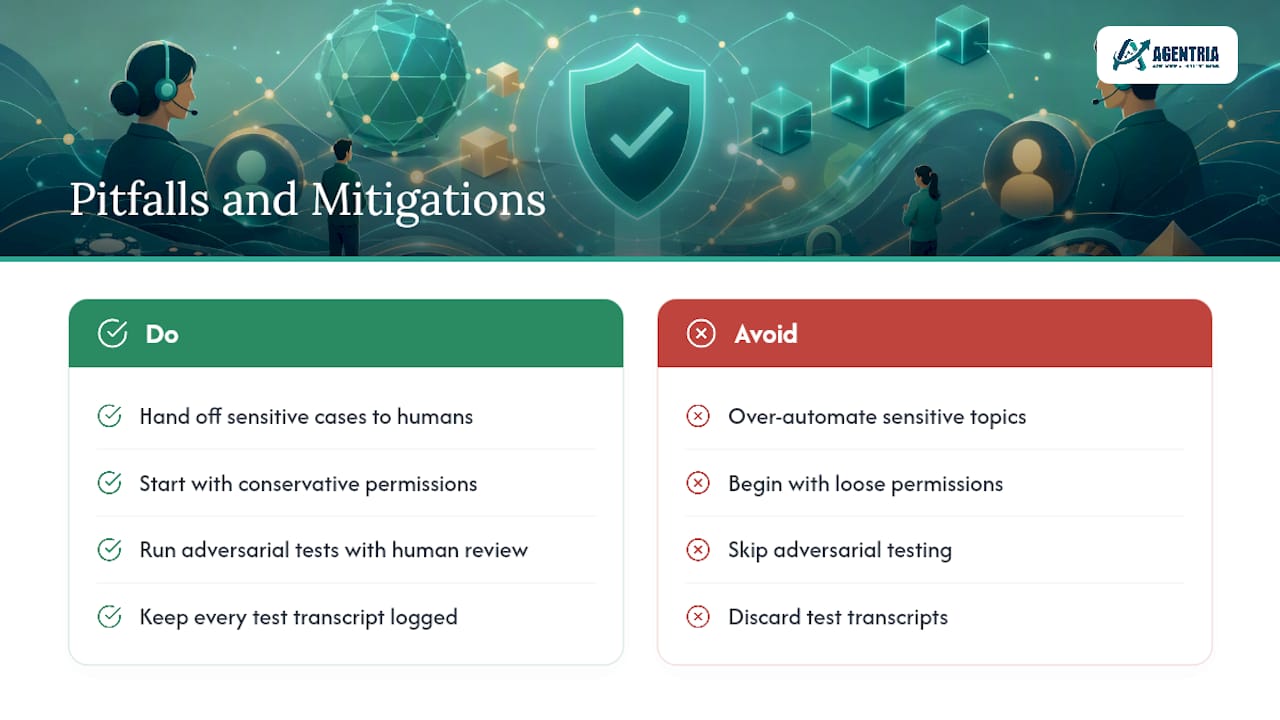
Over-automating sensitive topics is the single most common mistake. If a conversation touches money disputes, self-exclusion or emotional distress, it needs a human, full stop, no exceptions carved out for “obviously simple” cases.
The second mistake is starting with permissions too loose and tightening them later. Start conservative, widen access only once data justifies it. Third, test relentlessly for players trying to bait the persona into breaking character or revealing something it shouldn’t; human review is what catches these attempts before they reach a player.
Pro Tip: Keep every test transcript, not just the incidents. When an auditor asks how you validated the persona before launch, “we ran 200 adversarial scenarios and logged all of them” is a far stronger answer than a verbal assurance.
How Agentria operationalises persona safety
Agentria combines multiple AI providers with mandatory human review before any reply reaches a player, across email, live chat, SMS and Telegram. Every persona configuration runs through pre-send review or supervisory queues depending on risk level, with suppression rules that automatically halt outreach to flagged accounts. The result is a full audit trail, timestamped, reviewer-attributed, and structured exactly the way regulators expect to see it.
— AGENTRIA
See how Agentria fits your player support setup
Agentria is the alternative to running AI support on a single-provider script with no safety net, giving operators compliance-ready audit trails and human-in-the-loop review without slowing down response times.
Every persona built on the platform routes through pre-send review or supervisory queues before a reply reaches a player, with responsible gambling detection and outreach suppression built into the same dashboard used for VIP queue management. Channels, email, live chat, SMS, Telegram, share context automatically, so a player never has to repeat themselves switching between them. If you’re weighing up how AI customer support for online casino operators should actually be governed rather than just deployed, the feature breakdown covers permissioning, escalation and audit logging in detail. For operators handling their own multichannel admin workflows already, tools like Cardano Casino’s admin dashboard show how integration patterns fit alongside a persona layer. Book a demo to see the review queue and audit trail working against your own player data.
Sources
- The gaming industry looks ahead to 2025 — Gambling Insider
- Leveraging AI to protect people who gamble — IAGR (industry news)
- PersonaWeaver and procedural character generation — arXiv
Recommended
See AGENTRIA on your support workflow
Book a walkthrough tailored to your brands, channels, and compliance requirements.